Difference between revisions of "Resource:How to engage the university leadership in a design thinking workshop"
NickRussell (talk | contribs) |
|||
| Line 18: | Line 18: | ||
<span id="docs-internal-guid-01b9c43a-6152-f8f4-8db0-ecfea4701eb4"><span style="font-size: 14.6667px; font-family: Arial; color: rgb(0, 0, 0); vertical-align: baseline; white-space: pre-wrap; background-color: transparent;"> </span><span style="font-size: 14.6667px; font-family: Arial; color: rgb(0, 0, 0); vertical-align: baseline; white-space: pre-wrap; background-color: transparent;">How to get the right people in one room</span></span> | <span id="docs-internal-guid-01b9c43a-6152-f8f4-8db0-ecfea4701eb4"><span style="font-size: 14.6667px; font-family: Arial; color: rgb(0, 0, 0); vertical-align: baseline; white-space: pre-wrap; background-color: transparent;"> </span><span style="font-size: 14.6667px; font-family: Arial; color: rgb(0, 0, 0); vertical-align: baseline; white-space: pre-wrap; background-color: transparent;">How to get the right people in one room</span></span> | ||
| + | |||
| + | |||
| + | |||
| + | '''<br/>''' | ||
| + | |||
| + | '''<u>Setting up the event / logistics </u>''' | ||
| + | |||
| + | If you want to put on an executive leadership design thinking workshop like Tanner, one of the first hurdles to jump to your mind is probably getting everyone in the room. | ||
| + | |||
| + | 1. Find a date when another leadership event going on | ||
| + | |||
| + | a. Tanner was able to find out that there was a leadership training event going on at his school focusing on innovation. The great thing about leveraging one of these events is the people are already there and you just need to show up with your curriculum. | ||
| + | |||
| + | 2. Mini break out session within existing meeting | ||
| + | |||
| + | a. Find another university wide administrative meeting. At some universities this can be called university council or administrative council. You can find this information on the committees section of your universities’ website. Send an email to the committee chair and let them know what you are wanting to do. | ||
| + | |||
| + | 3. Contacting event planning personal within your president’s office. | ||
| + | |||
| + | a. Most University presidents or provosts’ office will have an event planning and coordinating staff. If you are able to get the approval of your president or provost, this staff should work with your to put on and coordinate the | ||
| + | |||
| + | 4. Putting on smaller event with leadership from your college or department | ||
| + | |||
| + | a. If you are just beginning as a fellow on your campus and do not have relationships with high level leadership, it can be smart to start having sessions with your faculty and administrators from your academic program or major. This will give you a chance to prototype your presentation and make connections with administrators who can introduce you to leadership is greater positions of authority. | ||
| + | |||
| + | 5. Using residential life as a stepping stone to other leaders | ||
| + | |||
| + | a. Residential life departments are always looking for interesting events and trainings to put on for students and their staffs. Putting on a good event for a dorm community or group of RA’s can be a great way to get on the radar of residential life administrators who might want to use your example. | ||
| + | |||
| + | 6. Building trust and respect on your campus | ||
| + | |||
| + | a. One of the major things that allowed Tanner to succeed is he had a track record of successful workshops on his campus. He started small, teaching freshman classes or covering for a teacher who had a sick day. For over a year he served his campus and built up good will with administrators around his university who saw he was truly passionate about this topic. | ||
| + | |||
| + | b. Though you may not have a year to begin working around your campus, you can start putting on innovation workshops for your peers and serving your campus community today. This will build good will that will be reciprocated back to you in the future. | ||
| + | |||
| + | |||
| + | |||
| + | |||
| + | |||
| + | |||
Revision as of 15:06, 21 January 2016
Category: |Discover]]
Introduction
What is this workshop? Who will you be teaching?
Goal and purpose
What do we want to accomplish? What impacts do we want to hhttp://universityinnovation.org/extensions/WYSIWYG/ckeditor/skins/kama/images/noimage.png?t=B49E5BQave?
This workshop is great if you don’t have enough money or space. A course to solve world problems.
Communications and Event Set Up
How to find stakeholders and show them you are worth their time
How to get the right people in one room
Setting up the event / logistics
If you want to put on an executive leadership design thinking workshop like Tanner, one of the first hurdles to jump to your mind is probably getting everyone in the room.
1. Find a date when another leadership event going on
a. Tanner was able to find out that there was a leadership training event going on at his school focusing on innovation. The great thing about leveraging one of these events is the people are already there and you just need to show up with your curriculum.
2. Mini break out session within existing meeting
a. Find another university wide administrative meeting. At some universities this can be called university council or administrative council. You can find this information on the committees section of your universities’ website. Send an email to the committee chair and let them know what you are wanting to do.
3. Contacting event planning personal within your president’s office.
a. Most University presidents or provosts’ office will have an event planning and coordinating staff. If you are able to get the approval of your president or provost, this staff should work with your to put on and coordinate the
4. Putting on smaller event with leadership from your college or department
a. If you are just beginning as a fellow on your campus and do not have relationships with high level leadership, it can be smart to start having sessions with your faculty and administrators from your academic program or major. This will give you a chance to prototype your presentation and make connections with administrators who can introduce you to leadership is greater positions of authority.
5. Using residential life as a stepping stone to other leaders
a. Residential life departments are always looking for interesting events and trainings to put on for students and their staffs. Putting on a good event for a dorm community or group of RA’s can be a great way to get on the radar of residential life administrators who might want to use your example.
6. Building trust and respect on your campus
a. One of the major things that allowed Tanner to succeed is he had a track record of successful workshops on his campus. He started small, teaching freshman classes or covering for a teacher who had a sick day. For over a year he served his campus and built up good will with administrators around his university who saw he was truly passionate about this topic.
b. Though you may not have a year to begin working around your campus, you can start putting on innovation workshops for your peers and serving your campus community today. This will build good will that will be reciprocated back to you in the future.
Curriculum and How to Teach
Teach Design Thinking:
The first step of this workshop is to teach the professors the process of design thinking. Knowing design thinking for themselves will allow the staff to pinpoint many problems that might not be visible to students such as you!
http://universityinnovation.org/wiki/File:Pasted_image_0.png
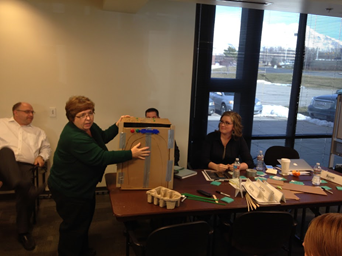
Explain the steps of design thinking to the professors. Following the explanation, engage them in activities that allow them to truly comprehend the process. One way is having them analyses a basic concept or object with the design thinking process. For example, one could use a garbage can as the object to be analyzed. Have the staff use the design thinking process to pinpoint problems that may be associated with garbage cans and their users. After they discuss a few problems, they should the come up with some solutions such as changes that can be made to the garbage can design or use. After figuring out ideas that solve the problems, encourage the professors to prototype their solutions. It is great to have a variety of rapid prototyping supplies such as markers, paper, cardboard, glue tape, and clay at the workshop. Have them make a physical model or demonstrate a use by role playing a scene. If possible, they should try to test these new designs or uses with other individuals at the workshop.
http://universityinnovation.org/images/e/e6/Pasted_image_0_%281%29.png
By teaching the members the process of design thinking through a fun and simple example, they become enthusiastic and invested in the process. After the professors have mastered design thinking, it is time to have them apply it to education. Have them define educational problems themselves. By defining these problems on their own, they become more familiar with the process and will come up with some problems you likely hadn’t even spotted. Have them formulate solutions and discuss them amongst themselves. Remember that one goal of this workshop is to encourage more involvement and collaboration between staff members.
http://universityinnovation.org/wiki/File:Pasted_image_0_(2).png
They should prototype and attempt to test their solutions just like they did with the garbage can example. It is important to note that there are many ways to ‘prototype,’ it doesn't always involve some physical model or device. You can have them act out a solution or draw out a plan or layout. Encourage creativity and collaboration!


.png)