Difference between revisions of "Priorities:Central Michigan University Student Priorities"
Dyonpadgett (talk | contribs) m (Changes made to student priorities page) |
|||
| (18 intermediate revisions by 10 users not shown) | |||
| Line 1: | Line 1: | ||
| + | ==<big>'''Central Michigan University 2025 Cohort'''</big>== | ||
| − | + | ===<u>Strategy #1: Virtual Reality Headset Simulation</u>=== | |
| + | '''Description/Background:''' | ||
| − | + | Virtual reality simulation headsets at Central Michigan University could provide students with immersive, hands-on learning experiences that closely mirror real-world environments. By allowing students to practice skills and explore scenarios in a safe, interactive setting, VR technology can enhance education across all departments, from nursing and engineering to business and the arts. This innovation would help bridge the gap between classroom learning and professional application, giving students valuable experience before entering their fields. Overall, implementing VR simulations would elevate CMU’s academic offerings and prepare students more effectively for success in their future careers. | |
| − | + | '''Team Lead: Jackson Raymond, Shamita Devanand''' | |
| − | + | ===<u>Strategy #2: Maroon Munchies</u>=== | |
| + | '''Description/Background:''' | ||
| − | + | A free food vending machine program at Central Michigan University could greatly support student well-being by addressing food insecurity and promoting healthier eating habits. By allowing students two free swipes per day for snacks or small meals, the system ensures that everyone has access to nourishment, even when time or money is limited. This initiative would particularly benefit busy students balancing classes, work, and extracurriculars who might otherwise skip meals. It also demonstrates CMU’s commitment to equity and student success by creating a caring, inclusive campus environment where no one has to learn on an empty stomach. If students need additional food or support, they can visit the CMU Student Food Pantry for more resources and assistance. | |
| − | Central Michigan University is in | + | '''Team Lead: Nicole Watts''' |
| + | |||
| + | ===<u>Strategy #3: Food Delivery Robots</u>=== | ||
| + | '''Description/Background:''' | ||
| + | |||
| + | Small food delivery robots could positively impact Central Michigan University by improving campus convenience, sustainability, and efficiency. These autonomous robots can deliver meals and snacks directly to students, faculty, and staff, reducing wait times and easing congestion at dining halls during peak hours. They promote sustainability by using electric power instead of fuel, lowering the university’s carbon footprint. Additionally, the technology can create learning and research opportunities for students in robotics, logistics, and business innovation, reinforcing CMU’s commitment to hands-on education and modern campus experiences. | ||
| + | |||
| + | '''Team Lead: Hoze Samson''' | ||
| + | |||
| + | ==<big>'''Central Michigan University 2024 Cohort'''</big>== | ||
| + | |||
| + | ===<u>Strategy #1: Greenspace Optimization</u>=== | ||
| + | |||
| + | ====Description/Background:==== | ||
| + | This project's intention is to turn unused campus grass greenspaces into usable study spaces, native plant gardens, community gardens, and play spaces. This would reduce mowing workload and noise pollution, increase the sense of community, and encourage students to spend time outdoors. The study spaces would include solar tables to give students places to study, sit, and spend time outside. The native plant gardens would increase the population of native pollinator species on campus and beautify the outdoor spaces. Community gardens could be used by RSOs like the garden club, and biology programs to study how crops grow in the Mount Pleasant climate. Lastly, the play spaces could include concrete ping pong, chess boards, and cornhole to be used by students, which creates a place to build community and gather outdoors. | ||
| + | |||
| + | ====Team Lead: Vibeke Rivet, Reeve Katt==== | ||
| + | |||
| + | ===<u>Strategy #2: Campus Resource Fair</u>=== | ||
| + | |||
| + | ====Description/Background:==== | ||
| + | This project would connect students with on-campus resources and where to find them on campus. This fair would ideally take place once per semester and would be used to introduce students to any resources on campus that they may not come across in their day-to-day to day lives. This includes on-campus counseling, food pantry, academic advising, career development center, and so many more. We have found that the majority of students don't know these things are available to them or just don't know where they are, and the CMU website isn't the easiest thing to navigate. This has been done on a small scale by the DEI office on campus, but we would want to expand it to be campus-wide. | ||
| + | |||
| + | ====Team Lead: Michelle Amoo==== | ||
| + | |||
| + | ===<u>Strategy #3: NVC Passion Project</u>=== | ||
| + | |||
| + | ====Description/Background:==== | ||
| + | The NVC competition through IBIE is a great opportunity for students to show off their skills and win large sums of money, but it is restrictive in who can be a part of it. In all technicality, anyone on campus can participate, but there are very few participants who reside in colleges outside of the CBA or E&T. We believe this may be because they don't think their skills align well with the competition itself, so we are proposing a new NVC category: Passion Project. This would be an open division where students could present whatever they are passionate about. Whether it's a sculpture, a piece of legislation, or a new program on campus, the students can let their imagination run wild to create something they really believe in. | ||
| + | |||
| + | ====Team Lead: Mela Hammond==== | ||
| + | |||
| + | ==<big>'''Central Michigan University 2023 Cohort'''</big>== | ||
| + | |||
| + | ===<big><u>Startegy #1: Study Abroad Mentorship with International Students</u></big>=== | ||
| + | |||
| + | ====Description Overview==== | ||
| + | Develop a mentorship program between international students and US citizen to create a cultural exchange. The goal is to make a more inclusive community on campus and inspire curiosity to explore the world. It would be a volunteer program in which students from all around campus can complete a survey/form to share their interests. Then, the students are paired up based on interests. There would be an orientation to go over the program and what it entails. | ||
| + | |||
| + | '''Team Leader:''' Carolina Hernandez Ruiz | ||
| + | |||
| + | '''Background:''' Many international students come to the USA without knowing anything about the culture. Most of the times, those students just talk with people from their same homecountry, therefore they don't get inverse in the community and experience the "american" culture. On the other hand, they are many U.S citizens who have never leave the country, and who want to study abroad but are scared to be in another country by themselves. | ||
| + | |||
| + | We want to connect all students around campus. We understand that may be challenges regarding students interests, specially between undegrad and grad international students. Another issue is the time commitment students would have if they do the program. We plan to contact the different students programs around the university, ex. Honors Program, LAS, MAC scholars, and the different Residential Colleges (Health Professions, Engineering, Education, Business). We want to work with the Volunteer Office to promote the mentorship program, which can count for volunteer hours for the students. Also, create a space on campus to meet new people. Students would go to this space on campus and meet new students, something similar to "English Cafe". | ||
| + | |||
| + | ===<big><u>Strategy #2: Departmental Blackboard Shell</u></big>=== | ||
| + | |||
| + | ====Description==== | ||
| + | Blackboard shell that organizes important information in one place. This can include job fairs, internship opportunities, lab opportunities on campus, and departmental scholarships. Blackboard is something that every student already uses for classes, so it would be easy for students to navigate. Many students feel that they could benefit from a place specific to their department for opportunities and other important information. The university sends out emails about broad topics, but departments do not. This would be an easy way to connect departmental opportunities to students. | ||
| + | |||
| + | ====Keys==== | ||
| + | The biggest key to this idea is who manages each blackboard shell. There are some departments that already have this and will be a great reference on who should manage the blackboard shell. It might be one person, but there is most likely going to be a team of people who have access to send out information. | ||
| + | |||
| + | '''Team leader:''' Maxwell Hornak | ||
| + | |||
| + | ===<big><u>'''Strategy #3: TEDx Salon Series'''</u></big>=== | ||
| + | '''Description Overview''' | ||
| + | |||
| + | The TEDx Salon Series is a 3 or 4 event series that tackles specific topics relevant to student issues. Within each salon event, participants will think about, discuss, and interact with one another to create solutions to prevalent issues. These events can include TED talks, panel discussions, activities, and more. | ||
| + | |||
| + | '''Team Leader:''' Tyler Thompson | ||
| + | |||
| + | One area of focus must be marketing the event. Not all students knew about a full TEDx conference in the Spring. It will be important that students know about this series of events so that they may have the opportunity to join the conversation. We can use social media and web traffic, assisted by the university and departments. We will also have to be intentional with salon topic selections and location selection as to best cater to what students want to learn, think, and discuss about. Finally, being even more prudent in planning activities and talks for the salons will be crucial in the overall effectiveness of the event. | ||
| + | |||
| + | The TEDx Salon Series will be built off of the momentum from the TEDx Conference hosted in April 2023. | ||
| + | |||
| + | ===<u><big>Strategy #4: Scholarship Fair</big></u>=== | ||
| + | '''Description''' | ||
| + | |||
| + | The scholarship fair will be an event where students are able to come and learn about the different scholarships available to them. They would potentially be able to apply of at minimum get started on some of them on site. | ||
| + | |||
| + | One issue that was addressed with this idea was how to make the event an easy space to navigate. It would be a waste of a students time to talk to a department outside of their major/minor. One way to combat this issue was to have a map of the layout with the tables labeled with which department is at which table. | ||
| + | |||
| + | '''Team Leader:''' Rebecca Ball | ||
| + | |||
| + | =='''<u><big>Central Michigan University 2022 Cohort</big></u>'''== | ||
| + | |||
| + | =='''Strategy #1: Developing a Culture of Creativity'''== | ||
| + | |||
| + | ==Tactic #1: Creativity Conference== | ||
| + | [[File:Creativity Conference.png|thumb|202x202px|link=Special:FilePath/Creativity_Conference.png]] | ||
| + | Description Overview | ||
| + | |||
| + | The creativity conference is a 1.5-2 day event that students will come to collaborate and develop their creative approach to problem-solving. As a physical location is feasible, this conference can also be held virtually and can be possible for students all across the world. | ||
| + | |||
| + | Team Leader: | ||
| + | |||
| + | *Leslee Weible | ||
| + | |||
| + | One issue that was brought up in trouble shooting was marketing the event. Some solutions might be that there could be coverage on different institutional social media and tabling on campus. Along with this, there was an issue with the way that the event was conveyed. There has to be enough information to entice the students to participate but also give them information that would let them know what this new event is really about and explain what it means in more than a couple vague sentences. | ||
| + | |||
| + | The creativity conference will be built off of the momentum of the series of consecutive creative jams that are hosted and implemented throughout the university. | ||
| + | |||
| + | =='''Strategy #2: Creating a Centralized Digital Resource Center'''== | ||
| + | |||
| + | ==Tactic #1: Social Media Account Content Delivery== | ||
| + | |||
| + | ===Description: The focus on the creation of an interactive resource center located within the cmich.edu website is the end goal for this strategy. To begin, we must start somewhere past various agile sprint cycles that must be developed to implement the website transformation... this is why, as we are meeting together with teams to edit cmich.edu, we will start with social media.=== | ||
| + | To begin with general resources, our base-case account will be built out of Instagram. | ||
| + | |||
| + | Team Leader: | ||
| + | |||
| + | *Jake Kapusansky | ||
| + | |||
| + | With implementation of resources, our strategy is to develop the content in 3 stages: people, places, niches. | ||
| + | |||
| + | #People first. Our first posts and stories will be featuring people, specifically agents of change on campus that other individuals can reach out to for resources and help. | ||
| + | #Places next. To understand all of the physical locations between CMU's various contexts, we will implement each internal resource inside of our various buildings | ||
| + | #The niche resources to include will be imperative as the collective student body begins to read between the lines for resource sharing and collaboration. (Ie., Adobe Creative Suite, etc.) | ||
| + | |||
| + | ==Tactic #2: Geographic Information System Implementation between University Website and Communications== | ||
| + | [[File:GIS.png|left|thumb|125x125px|link=Special:FilePath/GIS.png]] | ||
| + | ''Geographic Information System'' | ||
| + | |||
| + | we have included our prototype for what the website resource would look like. Rather than approaching the typical CMU map from a drivers lens, we need to connect people to people. | ||
| + | |||
| + | This is our prototype from social media account with the intention of being able to share information right away. Lastly, we will focus on scaling the idea from social to the website by collecting CMU resources over the next semester and working to collaborate with the web design team. | ||
| + | <br /> | ||
| + | |||
| + | =='''Strategy #3: Collaborate with Student-Led Initiatives to Implement Design Thinking Methodologies'''== | ||
| + | |||
| + | ==Tactic #1: Creative Jam/ Design Thinking Pop-Up(s)== | ||
| + | [[File:Creative Jam.png|thumb|298x298px|link=Special:FilePath/Creative_Jam.png]] | ||
| + | Description: The Creative Jam is designed for students having a hard time with academic burn out. When you think of the last time you were unapologetically creative, I personally think of when I was a kid. This brought up the idea of having a creative jam tabling event. | ||
| + | |||
| + | Team Leader: Rebecca Ridenour | ||
| + | |||
| + | Students will be able to come up on their own terms and experience childhood creativity like a sensory lab, group madlibs, and reflection activities. An issue that was experienced through trying to market this idea was that flyers do not attract students to events and students feel like they need a free item for coming to events. There was also another issue with the lack of information on my flier and what the goals were of the event. | ||
| + | |||
| + | The Creative Jam would be a great idea to get the interest of creativity embedded into students and make it, "if you participate you get entered to win a giftcard,” so the barriers to entry are as minimal as possible. The Creative Jam, based on input from our stakeholders has been pivoted to be a series of built up events, or "pop-ups" that will be very lean and easy to build over time. | ||
[[Category:Student Priorities]] | [[Category:Student Priorities]] | ||
[[Category:Central Michigan University]] | [[Category:Central Michigan University]] | ||
{{CatTree|Central_Michigan_University}} | {{CatTree|Central_Michigan_University}} | ||
Latest revision as of 02:30, 21 October 2025
Contents
- 1 Central Michigan University 2025 Cohort
- 2 Central Michigan University 2024 Cohort
- 3 Central Michigan University 2023 Cohort
- 4 Central Michigan University 2022 Cohort
- 5 Strategy #1: Developing a Culture of Creativity
- 6 Tactic #1: Creativity Conference
- 7 Strategy #2: Creating a Centralized Digital Resource Center
- 8 Tactic #1: Social Media Account Content Delivery
- 9 Tactic #2: Geographic Information System Implementation between University Website and Communications
- 10 Strategy #3: Collaborate with Student-Led Initiatives to Implement Design Thinking Methodologies
- 11 Tactic #1: Creative Jam/ Design Thinking Pop-Up(s)
Central Michigan University 2025 Cohort
Strategy #1: Virtual Reality Headset Simulation
Description/Background:
Virtual reality simulation headsets at Central Michigan University could provide students with immersive, hands-on learning experiences that closely mirror real-world environments. By allowing students to practice skills and explore scenarios in a safe, interactive setting, VR technology can enhance education across all departments, from nursing and engineering to business and the arts. This innovation would help bridge the gap between classroom learning and professional application, giving students valuable experience before entering their fields. Overall, implementing VR simulations would elevate CMU’s academic offerings and prepare students more effectively for success in their future careers.
Team Lead: Jackson Raymond, Shamita Devanand
Strategy #2: Maroon Munchies
Description/Background:
A free food vending machine program at Central Michigan University could greatly support student well-being by addressing food insecurity and promoting healthier eating habits. By allowing students two free swipes per day for snacks or small meals, the system ensures that everyone has access to nourishment, even when time or money is limited. This initiative would particularly benefit busy students balancing classes, work, and extracurriculars who might otherwise skip meals. It also demonstrates CMU’s commitment to equity and student success by creating a caring, inclusive campus environment where no one has to learn on an empty stomach. If students need additional food or support, they can visit the CMU Student Food Pantry for more resources and assistance.
Team Lead: Nicole Watts
Strategy #3: Food Delivery Robots
Description/Background:
Small food delivery robots could positively impact Central Michigan University by improving campus convenience, sustainability, and efficiency. These autonomous robots can deliver meals and snacks directly to students, faculty, and staff, reducing wait times and easing congestion at dining halls during peak hours. They promote sustainability by using electric power instead of fuel, lowering the university’s carbon footprint. Additionally, the technology can create learning and research opportunities for students in robotics, logistics, and business innovation, reinforcing CMU’s commitment to hands-on education and modern campus experiences.
Team Lead: Hoze Samson
Central Michigan University 2024 Cohort
Strategy #1: Greenspace Optimization
Description/Background:
This project's intention is to turn unused campus grass greenspaces into usable study spaces, native plant gardens, community gardens, and play spaces. This would reduce mowing workload and noise pollution, increase the sense of community, and encourage students to spend time outdoors. The study spaces would include solar tables to give students places to study, sit, and spend time outside. The native plant gardens would increase the population of native pollinator species on campus and beautify the outdoor spaces. Community gardens could be used by RSOs like the garden club, and biology programs to study how crops grow in the Mount Pleasant climate. Lastly, the play spaces could include concrete ping pong, chess boards, and cornhole to be used by students, which creates a place to build community and gather outdoors.
Team Lead: Vibeke Rivet, Reeve Katt
Strategy #2: Campus Resource Fair
Description/Background:
This project would connect students with on-campus resources and where to find them on campus. This fair would ideally take place once per semester and would be used to introduce students to any resources on campus that they may not come across in their day-to-day to day lives. This includes on-campus counseling, food pantry, academic advising, career development center, and so many more. We have found that the majority of students don't know these things are available to them or just don't know where they are, and the CMU website isn't the easiest thing to navigate. This has been done on a small scale by the DEI office on campus, but we would want to expand it to be campus-wide.
Team Lead: Michelle Amoo
Strategy #3: NVC Passion Project
Description/Background:
The NVC competition through IBIE is a great opportunity for students to show off their skills and win large sums of money, but it is restrictive in who can be a part of it. In all technicality, anyone on campus can participate, but there are very few participants who reside in colleges outside of the CBA or E&T. We believe this may be because they don't think their skills align well with the competition itself, so we are proposing a new NVC category: Passion Project. This would be an open division where students could present whatever they are passionate about. Whether it's a sculpture, a piece of legislation, or a new program on campus, the students can let their imagination run wild to create something they really believe in.
Team Lead: Mela Hammond
Central Michigan University 2023 Cohort
Startegy #1: Study Abroad Mentorship with International Students
Description Overview
Develop a mentorship program between international students and US citizen to create a cultural exchange. The goal is to make a more inclusive community on campus and inspire curiosity to explore the world. It would be a volunteer program in which students from all around campus can complete a survey/form to share their interests. Then, the students are paired up based on interests. There would be an orientation to go over the program and what it entails.
Team Leader: Carolina Hernandez Ruiz
Background: Many international students come to the USA without knowing anything about the culture. Most of the times, those students just talk with people from their same homecountry, therefore they don't get inverse in the community and experience the "american" culture. On the other hand, they are many U.S citizens who have never leave the country, and who want to study abroad but are scared to be in another country by themselves.
We want to connect all students around campus. We understand that may be challenges regarding students interests, specially between undegrad and grad international students. Another issue is the time commitment students would have if they do the program. We plan to contact the different students programs around the university, ex. Honors Program, LAS, MAC scholars, and the different Residential Colleges (Health Professions, Engineering, Education, Business). We want to work with the Volunteer Office to promote the mentorship program, which can count for volunteer hours for the students. Also, create a space on campus to meet new people. Students would go to this space on campus and meet new students, something similar to "English Cafe".
Strategy #2: Departmental Blackboard Shell
Description
Blackboard shell that organizes important information in one place. This can include job fairs, internship opportunities, lab opportunities on campus, and departmental scholarships. Blackboard is something that every student already uses for classes, so it would be easy for students to navigate. Many students feel that they could benefit from a place specific to their department for opportunities and other important information. The university sends out emails about broad topics, but departments do not. This would be an easy way to connect departmental opportunities to students.
Keys
The biggest key to this idea is who manages each blackboard shell. There are some departments that already have this and will be a great reference on who should manage the blackboard shell. It might be one person, but there is most likely going to be a team of people who have access to send out information.
Team leader: Maxwell Hornak
Strategy #3: TEDx Salon Series
Description Overview
The TEDx Salon Series is a 3 or 4 event series that tackles specific topics relevant to student issues. Within each salon event, participants will think about, discuss, and interact with one another to create solutions to prevalent issues. These events can include TED talks, panel discussions, activities, and more.
Team Leader: Tyler Thompson
One area of focus must be marketing the event. Not all students knew about a full TEDx conference in the Spring. It will be important that students know about this series of events so that they may have the opportunity to join the conversation. We can use social media and web traffic, assisted by the university and departments. We will also have to be intentional with salon topic selections and location selection as to best cater to what students want to learn, think, and discuss about. Finally, being even more prudent in planning activities and talks for the salons will be crucial in the overall effectiveness of the event.
The TEDx Salon Series will be built off of the momentum from the TEDx Conference hosted in April 2023.
Strategy #4: Scholarship Fair
Description
The scholarship fair will be an event where students are able to come and learn about the different scholarships available to them. They would potentially be able to apply of at minimum get started on some of them on site.
One issue that was addressed with this idea was how to make the event an easy space to navigate. It would be a waste of a students time to talk to a department outside of their major/minor. One way to combat this issue was to have a map of the layout with the tables labeled with which department is at which table.
Team Leader: Rebecca Ball
Central Michigan University 2022 Cohort
Strategy #1: Developing a Culture of Creativity
Tactic #1: Creativity Conference
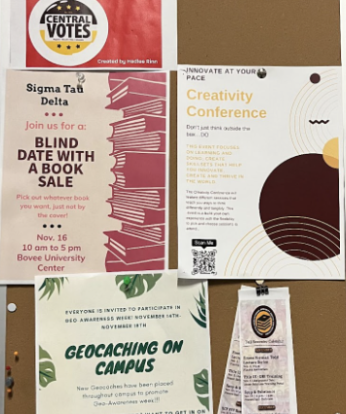
Description Overview
The creativity conference is a 1.5-2 day event that students will come to collaborate and develop their creative approach to problem-solving. As a physical location is feasible, this conference can also be held virtually and can be possible for students all across the world.
Team Leader:
- Leslee Weible
One issue that was brought up in trouble shooting was marketing the event. Some solutions might be that there could be coverage on different institutional social media and tabling on campus. Along with this, there was an issue with the way that the event was conveyed. There has to be enough information to entice the students to participate but also give them information that would let them know what this new event is really about and explain what it means in more than a couple vague sentences.
The creativity conference will be built off of the momentum of the series of consecutive creative jams that are hosted and implemented throughout the university.
Strategy #2: Creating a Centralized Digital Resource Center
Tactic #1: Social Media Account Content Delivery
Description: The focus on the creation of an interactive resource center located within the cmich.edu website is the end goal for this strategy. To begin, we must start somewhere past various agile sprint cycles that must be developed to implement the website transformation... this is why, as we are meeting together with teams to edit cmich.edu, we will start with social media.
To begin with general resources, our base-case account will be built out of Instagram.
Team Leader:
- Jake Kapusansky
With implementation of resources, our strategy is to develop the content in 3 stages: people, places, niches.
- People first. Our first posts and stories will be featuring people, specifically agents of change on campus that other individuals can reach out to for resources and help.
- Places next. To understand all of the physical locations between CMU's various contexts, we will implement each internal resource inside of our various buildings
- The niche resources to include will be imperative as the collective student body begins to read between the lines for resource sharing and collaboration. (Ie., Adobe Creative Suite, etc.)
Tactic #2: Geographic Information System Implementation between University Website and Communications
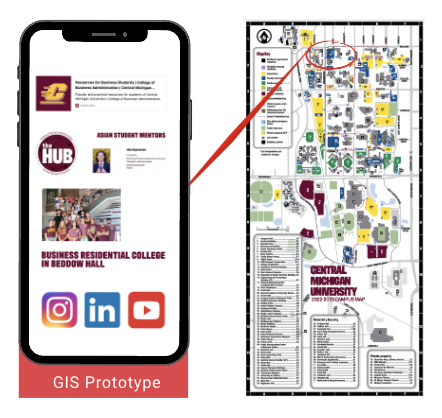
Geographic Information System
we have included our prototype for what the website resource would look like. Rather than approaching the typical CMU map from a drivers lens, we need to connect people to people.
This is our prototype from social media account with the intention of being able to share information right away. Lastly, we will focus on scaling the idea from social to the website by collecting CMU resources over the next semester and working to collaborate with the web design team.
Strategy #3: Collaborate with Student-Led Initiatives to Implement Design Thinking Methodologies
Tactic #1: Creative Jam/ Design Thinking Pop-Up(s)
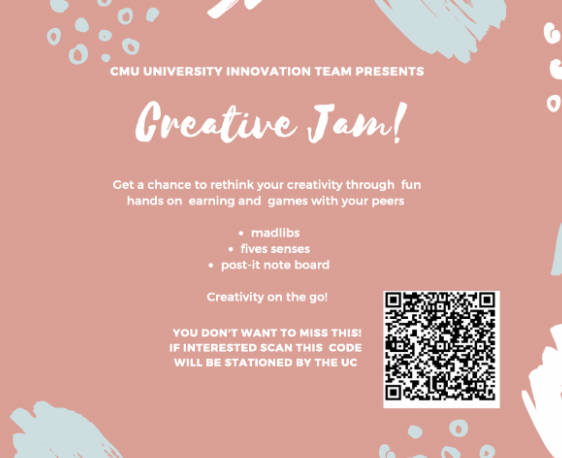
Description: The Creative Jam is designed for students having a hard time with academic burn out. When you think of the last time you were unapologetically creative, I personally think of when I was a kid. This brought up the idea of having a creative jam tabling event.
Team Leader: Rebecca Ridenour
Students will be able to come up on their own terms and experience childhood creativity like a sensory lab, group madlibs, and reflection activities. An issue that was experienced through trying to market this idea was that flyers do not attract students to events and students feel like they need a free item for coming to events. There was also another issue with the lack of information on my flier and what the goals were of the event.
The Creative Jam would be a great idea to get the interest of creativity embedded into students and make it, "if you participate you get entered to win a giftcard,” so the barriers to entry are as minimal as possible. The Creative Jam, based on input from our stakeholders has been pivoted to be a series of built up events, or "pop-ups" that will be very lean and easy to build over time.
Related links


