Difference between revisions of "School:Universidad Tecnológica del Uruguay (UTEC)"
| (59 intermediate revisions by 13 users not shown) | |||
| Line 1: | Line 1: | ||
| − | + | [[File:UTEC logo.png|thumb|UTEC Logo|link=Special:FilePath/UTEC_logo.png]] | |
| + | =Overview= | ||
| + | [[File:ITRSO.jpg|thumb|UTEC, Fray Bentos|link=Special:FilePath/ITRSO.jpg]] | ||
| + | [[File:ITRCS.jpg|thumb|UTEC, Durazno|link=Special:FilePath/ITRCS.jpg]] | ||
| + | [[File:ITRN.jpg|thumb|UTEC, Rivera|link=Special:FilePath/ITRN.jpg]] | ||
| − | = | + | UTEC is a proposal of public education, with a technological profile, committed to the expansion of the higher education supply to the interior of Uruguay (the main idea was to settle or locate the University in the interior of the country); fostering the link with the productive environment and the promotion of the country's social and cultural development. This university has a wide and diverse list of available careers that include pregrade, grade and postgrade, while complementing them with many programs and courses to complete the student curricula. |
| + | <p dir="ltr" style="line-height: 1.38; margin-top: 0pt; margin-bottom: 0pt; text-indent: 36pt; text-align: justify;"></p> | ||
| − | + | ==Vision:== | |
| + | To be the Uruguayan public university of Higher Technological Education, recognized nationally and internationally for its commitment to continuous quality improvement, equal opportunities and innovative capacity of its educational and research offer, which forms people with a creative and entrepreneurial professional profile in strategic areas, for an equitable and inclusive social and economic development. | ||
| − | + | ==Values:== | |
| + | <ul style="margin-left: 80px;"> | ||
| + | <li><p dir="ltr" style="text-align: justify;">Team work within the institution and the National System of Public Education.</p></li> | ||
| + | <li><p dir="ltr" style="text-align: justify;">Recognition of the multiple competences of local actors that facilitate coordinated work and proximity in the interior of the country.</p></li> | ||
| + | <li><p dir="ltr" style="text-align: justify;">Academic excellence in educational processes and development of innovations.</p></li> | ||
| + | <li><p dir="ltr" style="text-align: justify;">Flexibility</p></li> | ||
| + | <li><p dir="ltr" style="text-align: justify;">Transparency and accountability to society.</p></li> | ||
| + | <li><p dir="ltr" style="text-align: justify;">Social commitment and equity in access to education.</p></li> | ||
| + | <li><p dir="ltr" style="text-align: justify;">Certified quality in processes and products.</p></li> | ||
| + | </ul> | ||
| − | + | ==Our mission:== | |
| + | To educate, train and coach high level professionals, entrepreneurs and innovators in order to generate, transform, transfer and articulate knowledge to promote and boost the technological, economic and social development of Uruguay. | ||
| − | = Promoting student innovation and entrepreneurship = | + | =Promoting student innovation and entrepreneurship= |
| − | + | This section provides opportunities for both UTEC students and external individuals. The goal is to mentor them in the field of entrepreneurship, whether they have an idea or already have a business in place. From that point, they meet with experts who guide them through the subsequent steps in the best possible way. If the experts see potential in that idea or business, they assist in securing external funding from sources outside of UTEC to bring that idea to fruition. Recently, many campuses have introduced modern infrastructure, including co-working spaces that students, professors, and, in some cases, community members can use to develop their ideas or network. | |
| − | + | =Encouraging faculty innovation and entrepreneurship= | |
| − | + | This sector is similar to the previous one; the difference lies in that these are already advanced and operational businesses requiring a different type of guidance on how to expand. This expansion includes various areas such as e-commerce, marketing, and social media. Additionally, they are connected with governmental entities or specific financing programs tailored for small and medium-sized enterprises (SMEs). | |
| − | + | =Actively supporting the university technology transfer function= | |
| − | + | In this area, courses are provided for entrepreneurs who wish to learn or enhance their use of the Excel tool, delivered by a renowned professor and accountant, all free of charge. For individuals with a specific idea who want to prototype it, this is made possible through 3D modeling. UTEC boasts state-of-the-art 3D printers and also offers modeling courses, which is innovative in the region. This is because few places in the country provide these types of tools. | |
| − | = | + | =Facilitating university-industry collaboration= |
| − | + | In this section, various types of conferences have been organized, where UTEC has covered the expenses to bring relevant actors from global supply chains to share their experiences. Additionally, there is an exchange of knowledge with all participants through interactive question sessions. In the field of robotics, a competition was held, attracting participants from the neighboring country, Brazil, who competed with Uruguayan students and exchanged knowledge. All of this took place during a week where they could share, compete, and learn about the robotics field. | |
| − | + | =Engaging with regional and local economic development efforts= | |
| − | + | In this section, various types of in-person gatherings were organized, with the participation of UTEC students from across Uruguay. In addition, specific conferences were held, focusing on environmental sustainability, with the aim of exploring what we can do to bring about sustainable change. UTEC also promotes cultural diversity by hosting some events that creates opportunities to connect and share our different traditions. | |
| − | + | [[File:UTEC Global.png|thumb|UTEC Global|link=Special:FilePath/UTEC_Global.png]] | |
| − | + | =International Relations Unit= | |
| − | + | The International Relations Unit promotes and maintains links with foreign institutions and organizations that strengthen academic and research activity through networks of universities, research centers and international organizations, academic exchanges and joint programs. | |
| − | + | Internationalization in its broadest sense and integrated to management, allows universities to be part of international trends in education and learning, as well as to provide all their students with the necessary resources to make a positive contribution to society. | |
| − | + | =UTEC in the Territory= | |
| + | [[File:8-diseno-memoria-anual-nomade-estudio-punta-del-este.jpg|thumb|UTEC in the Territory|link=Special:FilePath/8-diseno-memoria-anual-nomade-estudio-punta-del-este.jpg]] | ||
| − | + | The Regional Technological Institutes (ITRs, by its acronym in Spanish) are the manifestation of UTEC in the territory (the campus).They are located on different regions in the country, based on the local needs for higher education in each place. They are the centers that manage the activities in the region; in order to create a dialogue with the environment, through a strong decentralized profesional path. | |
| − | + | When UTEC was first created its main focus was to decentralize centers of higher education in the country from the capital. At the time all uruguayan students could mostly do if they wanted to pursue a college career was to move to Montevideo, and study there. This drastically changed with the arrival of UTEC. Its first institution was built in the southwest part of the country, Fray Bentos. Since then on, all ITRs built have been following the same path and have been designed to fit the communities they were built around. | |
| − | + | In UTEC centers don't focus on just one area with a fixed list of careers, since its purpose is to provide more access to education, in each building you can have very different careers from different departments. | |
| − | and | + | There are many centers throughout the country that belong to UTEC, where the faculty's offices and the classrooms are located. Each center belongs to a subgroup in the university according to its location, this groups are the ITRs. There are currently three well established (although still growing) ITRs, and a fourth one that is still being implemented (athough already working). The ITRs and their assigned centers are the following: |
| − | + | *ITR Southwest | |
| − | + | #Fray Bentos, Río Negro | |
| + | #Mercedes, Mercedes | ||
| + | #La Paz, Colonia | ||
| + | #Nueva Helvecia, Colonia | ||
| + | #Paysandú, Paysandú | ||
| + | *ITR Center-South | ||
| + | #Durazno, Durazno | ||
| + | #San José, San José | ||
| + | #Maldonado, Maldonado (Currently) | ||
| − | + | *ITR North | |
| + | |||
| + | #Rivera, Rivera | ||
| + | #Melo, Cerro Largo | ||
| + | |||
| + | *ITR East (Still being implemented) | ||
| + | |||
| + | #Minas, Lavalleja | ||
| + | #Maldonado, Maldonado (In the future) | ||
| + | |||
| + | The three main and bigger centers (in terms of size, careers offered and students attending) are the ones located in Durazno, Fray Bentos and Rivera. | ||
| + | |||
| + | =Related Links= | ||
| + | |||
| + | [https://utec.edu.uy/es/?pa=inicio UTEC] | ||
| + | |||
| + | [http://universityinnovation.org/wiki/Universidad_Tecnol%C3%B3gica_del_Uruguay_(UTEC)_Student_Priorities UTEC [STUDENTS PRIORITIES]] | ||
| + | |||
| + | [http://universityinnovation.org/wiki/UNIVERSIDAD_TECNOL%C3%93GICA_DEL_URUGUAY_(UTEC)_STRATEGIC_PRIORITIES UTEC [STRATEGIC PRIORITIES]] | ||
| + | |||
| + | [https://www.youtube.com/watch?v=DhqifS4oDmY Becoming UTEC (Storytelling video link)] | ||
| + | |||
| + | [https://utec.edu.uy/es/educacion/ Available careers] | ||
| + | |||
| + | Spring 2017 UIFs: | ||
| + | |||
| + | [http://universityinnovation.org/wiki/Mathias_Rosas Mathias Rosas] | ||
| + | |||
| + | [https://docs.google.com/spreadsheets/d/1VDeSItXewnrhmh1ElOIp6i83dcs_qoVTEBkRb9-CQyo/edit#gid=0 Landscape Canvas 2017] | ||
| + | |||
| + | Fall 2018 UIFs: | ||
| + | |||
| + | [http://universityinnovation.org/wiki/User:Icapdevila Irina Capdevila Gonzalez] | ||
| + | |||
| + | [http://universityinnovation.org/wiki/Natalia_Suarez Natalia Suarez] | ||
| + | |||
| + | |||
| + | |||
| + | [https://docs.google.com/spreadsheets/d/1JpGamgzte3b8LfkGR39p_X5M1sHJeZlGHtP8w7Y8Mis/edit#gid=0 Landscape Canvas 2018] | ||
| + | |||
| + | Fall 2020 UIFs: | ||
| + | |||
| + | [https://universityinnovation.org/wiki/Fellow:Ainara_Saralegui Ainara Saralegui] | ||
| + | |||
| + | [https://universityinnovation.org/wiki/Fellow:Juan_ignacio_silva_silva Ignacio Silva] | ||
| + | |||
| + | [https://docs.google.com/spreadsheets/d/1K5cMzPK-EwQhNyJ0_TITpitE4YZbDJ-oAmfwRPb2XtE/edit#gid=0 Landscape Canvas 2020] | ||
| + | |||
| + | Fall 2021 UIFs: | ||
| + | |||
| + | Sofia Alfonso [https://universityinnovation.org/wiki/Fellow:Sofia_Alfonso] | ||
| + | |||
| + | Elisa Perez [https://universityinnovation.org/wiki/Fellow:Elisa_Perez] | ||
| + | |||
| + | Victoria Pitetta [https://universityinnovation.org/wiki/Fellow:Victoria_Pitetta] | ||
| + | |||
| + | Landscape Canvas 2021 [https://docs.google.com/spreadsheets/d/1qpvqxTQ72kM_ig-izNMXinw81a0II5C_3h1i0vrpabE/edit#gid=0] | ||
| + | |||
| + | |||
| + | <!-- DO NOT EDIT BELOW THIS LINE --> | ||
| + | [[Category:Universities]] | ||
| + | [[Category:Schools]] | ||
| + | [[Category:Universidad_Tecnológica_del_Uruguay]] | ||
| + | |||
| + | {{CatTree|Universidad_Tecnológica_del_Uruguay}} | ||
Latest revision as of 01:31, 14 September 2024

Contents
- 1 Overview
- 2 Promoting student innovation and entrepreneurship
- 3 Encouraging faculty innovation and entrepreneurship
- 4 Actively supporting the university technology transfer function
- 5 Facilitating university-industry collaboration
- 6 Engaging with regional and local economic development efforts
- 7 International Relations Unit
- 8 UTEC in the Territory
- 9 Related Links
Overview
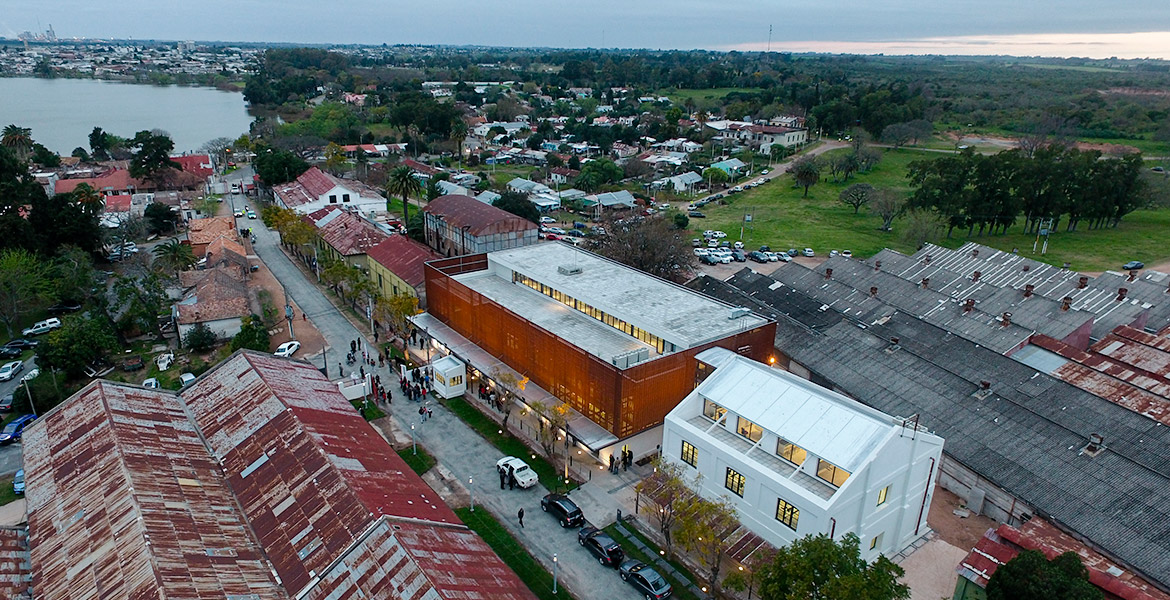


UTEC is a proposal of public education, with a technological profile, committed to the expansion of the higher education supply to the interior of Uruguay (the main idea was to settle or locate the University in the interior of the country); fostering the link with the productive environment and the promotion of the country's social and cultural development. This university has a wide and diverse list of available careers that include pregrade, grade and postgrade, while complementing them with many programs and courses to complete the student curricula.
Vision:
To be the Uruguayan public university of Higher Technological Education, recognized nationally and internationally for its commitment to continuous quality improvement, equal opportunities and innovative capacity of its educational and research offer, which forms people with a creative and entrepreneurial professional profile in strategic areas, for an equitable and inclusive social and economic development.
Values:
Team work within the institution and the National System of Public Education.
Recognition of the multiple competences of local actors that facilitate coordinated work and proximity in the interior of the country.
Academic excellence in educational processes and development of innovations.
Flexibility
Transparency and accountability to society.
Social commitment and equity in access to education.
Certified quality in processes and products.
Our mission:
To educate, train and coach high level professionals, entrepreneurs and innovators in order to generate, transform, transfer and articulate knowledge to promote and boost the technological, economic and social development of Uruguay.
Promoting student innovation and entrepreneurship
This section provides opportunities for both UTEC students and external individuals. The goal is to mentor them in the field of entrepreneurship, whether they have an idea or already have a business in place. From that point, they meet with experts who guide them through the subsequent steps in the best possible way. If the experts see potential in that idea or business, they assist in securing external funding from sources outside of UTEC to bring that idea to fruition. Recently, many campuses have introduced modern infrastructure, including co-working spaces that students, professors, and, in some cases, community members can use to develop their ideas or network.
Encouraging faculty innovation and entrepreneurship
This sector is similar to the previous one; the difference lies in that these are already advanced and operational businesses requiring a different type of guidance on how to expand. This expansion includes various areas such as e-commerce, marketing, and social media. Additionally, they are connected with governmental entities or specific financing programs tailored for small and medium-sized enterprises (SMEs).
Actively supporting the university technology transfer function
In this area, courses are provided for entrepreneurs who wish to learn or enhance their use of the Excel tool, delivered by a renowned professor and accountant, all free of charge. For individuals with a specific idea who want to prototype it, this is made possible through 3D modeling. UTEC boasts state-of-the-art 3D printers and also offers modeling courses, which is innovative in the region. This is because few places in the country provide these types of tools.
Facilitating university-industry collaboration
In this section, various types of conferences have been organized, where UTEC has covered the expenses to bring relevant actors from global supply chains to share their experiences. Additionally, there is an exchange of knowledge with all participants through interactive question sessions. In the field of robotics, a competition was held, attracting participants from the neighboring country, Brazil, who competed with Uruguayan students and exchanged knowledge. All of this took place during a week where they could share, compete, and learn about the robotics field.
Engaging with regional and local economic development efforts
In this section, various types of in-person gatherings were organized, with the participation of UTEC students from across Uruguay. In addition, specific conferences were held, focusing on environmental sustainability, with the aim of exploring what we can do to bring about sustainable change. UTEC also promotes cultural diversity by hosting some events that creates opportunities to connect and share our different traditions.
International Relations Unit
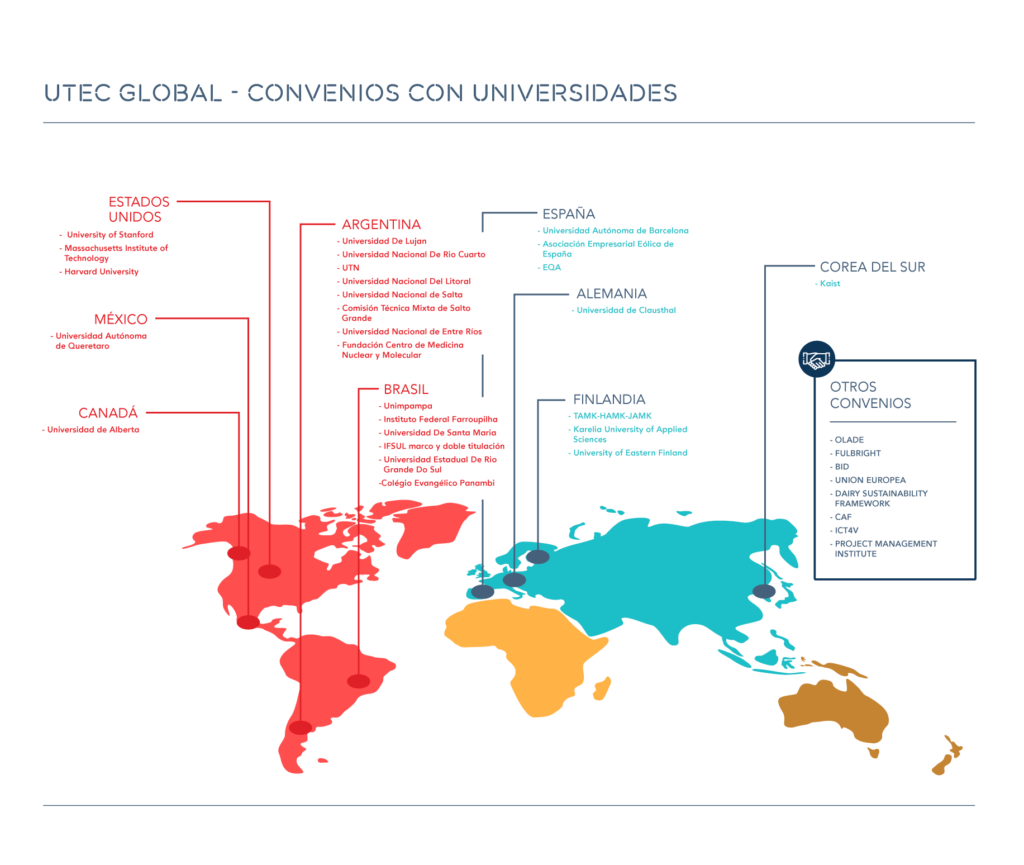
The International Relations Unit promotes and maintains links with foreign institutions and organizations that strengthen academic and research activity through networks of universities, research centers and international organizations, academic exchanges and joint programs.
Internationalization in its broadest sense and integrated to management, allows universities to be part of international trends in education and learning, as well as to provide all their students with the necessary resources to make a positive contribution to society.
UTEC in the Territory
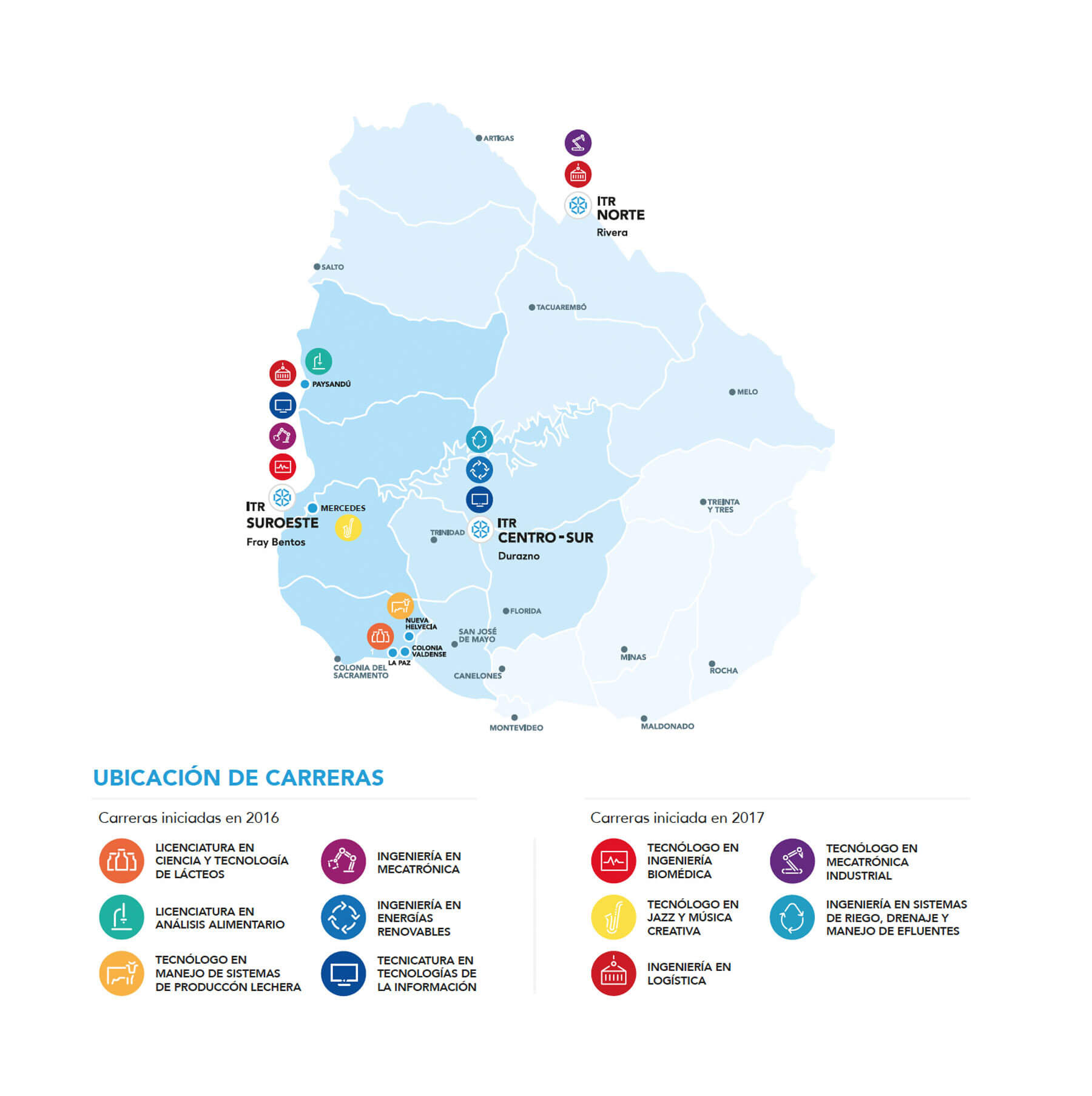
The Regional Technological Institutes (ITRs, by its acronym in Spanish) are the manifestation of UTEC in the territory (the campus).They are located on different regions in the country, based on the local needs for higher education in each place. They are the centers that manage the activities in the region; in order to create a dialogue with the environment, through a strong decentralized profesional path.
When UTEC was first created its main focus was to decentralize centers of higher education in the country from the capital. At the time all uruguayan students could mostly do if they wanted to pursue a college career was to move to Montevideo, and study there. This drastically changed with the arrival of UTEC. Its first institution was built in the southwest part of the country, Fray Bentos. Since then on, all ITRs built have been following the same path and have been designed to fit the communities they were built around.
In UTEC centers don't focus on just one area with a fixed list of careers, since its purpose is to provide more access to education, in each building you can have very different careers from different departments.
There are many centers throughout the country that belong to UTEC, where the faculty's offices and the classrooms are located. Each center belongs to a subgroup in the university according to its location, this groups are the ITRs. There are currently three well established (although still growing) ITRs, and a fourth one that is still being implemented (athough already working). The ITRs and their assigned centers are the following:
- ITR Southwest
- Fray Bentos, Río Negro
- Mercedes, Mercedes
- La Paz, Colonia
- Nueva Helvecia, Colonia
- Paysandú, Paysandú
- ITR Center-South
- Durazno, Durazno
- San José, San José
- Maldonado, Maldonado (Currently)
- ITR North
- Rivera, Rivera
- Melo, Cerro Largo
- ITR East (Still being implemented)
- Minas, Lavalleja
- Maldonado, Maldonado (In the future)
The three main and bigger centers (in terms of size, careers offered and students attending) are the ones located in Durazno, Fray Bentos and Rivera.
Related Links
Becoming UTEC (Storytelling video link)
Spring 2017 UIFs:
Fall 2018 UIFs:
Fall 2020 UIFs:
Fall 2021 UIFs:
Sofia Alfonso [1]
Elisa Perez [2]
Victoria Pitetta [3]
Landscape Canvas 2021 [4]
Related links


