Difference between revisions of "Priorities:Hamburg University of Technology Student Priorities"
An.so.schmia (talk | contribs) |
|||
| (20 intermediate revisions by 4 users not shown) | |||
| Line 1: | Line 1: | ||
| + | =Cohort Fall 2025= | ||
| + | [[Fellow:Dominik_Wittenhagen|Dominik_Wittenhagen]] | ||
| + | |||
| + | [[Fellow:Nithyashree Ravishankar|Nithyashree Ravishankar]] | ||
| + | |||
| + | [[Fellow:Rishabh Shukla|Rishabh Shukla]] | ||
| + | |||
| + | [[Fellow:Sri Valli Lahari Meenakshi Kanchibhotla|Sri Valli Lahari Meenakshi Kanchibhotla]] | ||
| + | |||
| + | ==Project #1 - Mind Matters== | ||
| + | [[File:Mind Matters.png|thumb|link=Special:FilePath/Mind Matters.png]] | ||
| + | At TUHH, student well-being is increasingly being recognized as a vital part of academic and personal success. The TUHH already offers valuable counseling support and targeted workshops for different student groups, helping them manage challenges such as stress, cultural adjustment, and academic pressure. | ||
| + | |||
| + | Yet, even with these resources, many students hesitate to seek help. The reasons are often not about access but about comfort; it can be the fear of being judged, misunderstood, or seen as “struggling.” This hesitation leaves a gap between the support available and the support actually received. | ||
| + | |||
| + | '''''Mind Matters''''' seeks to bridge that gap. It is an initiative to create a culture of open and stigma-free conversations around mental health at TUHH. The aim is not only to support those facing visible mental health challenges but also to provide a space for any student who wants to talk, reflect, or simply connect. | ||
| + | |||
| + | The vision is to build a safe, welcoming space, both physical and digital, where students can share experiences, find peer support, and learn new ways to care for their wellbeing. The concept extends beyond traditional counselling by including peer-to-peer reflection circles, creative expression sessions (like journaling or open mics), and community events that strengthen a sense of belonging. | ||
| + | |||
| + | Mind Matters will also collaborate closely with student bodies and faculty members to complement existing support systems while encouraging more informal, everyday engagement with wellbeing. | ||
| + | |||
| + | Ultimately, Mind Matters aims to shift the conversation around mental health, from something personal and private to something collective, open, and empowering for the entire TUHH community. | ||
| + | |||
| + | ===Strategic Priorities=== | ||
| + | '''[1] Establish a central point of access for all mental health and wellbeing resources.''' | ||
| + | |||
| + | '''[2] Encourage peer-led and informal support systems (e.g., reflection cafés, art or journaling spaces).''' | ||
| + | |||
| + | '''[3] Strengthen community belonging by bridging cultural and academic gaps, especially for international students.''' | ||
| + | |||
| + | '''[4] Integrate preventive wellbeing education into campus life through events, workshops, and digital campaigns.''' | ||
| + | |||
| + | ===Next Steps=== | ||
| + | '''[1] Research existing mental health and wellbeing programs already offered at TUHH and nearby universities.''' | ||
| + | |||
| + | '''[2] Design a prototype template for ''Mind Matters'' that encourages students to engage and participate.''' | ||
| + | |||
| + | '''[3] Collect student feedback to refine the concept into something both useful and approachable.''' | ||
| + | |||
| + | '''[4] Begin testing with small-scale pilot activities like informal wellbeing sessions or peer cafés.''' | ||
| + | |||
| + | ==Project #2 - EcoTUHH== | ||
| + | [[File:EcoTUHH.png|thumb|link=Special:FilePath/EcoTUHH.png]] | ||
| + | Sustainability has become one of the most defining topics of our timeand TUHH, as a university of technology, is uniquely positioned to lead by example. Across campus, several initiatives already contribute to a greener TUHH: the Mensa’s vegetarian and vegan days, discounts on leftover food, and carbon footprint labels on meals are meaningful steps in encouraging responsible choices. Some previous projects, such as bicycle stand programs and Blue Engineering student initiatives, have also shown how much students care about sustainable living. | ||
| + | |||
| + | Yet, many of these efforts remain isolated, and students often struggle to see how their individual actions connect to the bigger sustainability picture on campus. This is where EcoTUHH steps in. | ||
| + | |||
| + | EcoTUHH envisions the TUHH campus as a living laboratory for sustainability, a place where ideas are not just discussed but experienced, tested, and shared. It aims to empower students, staff, and faculty to collaboratively turn sustainability into visible, everyday practice. | ||
| + | |||
| + | The initiative will bring together existing resources and new student-led projects under one umbrella, from waste-sorting workshops and digital carbon awareness campaigns to eco-challenges, campus gardening, and energy-saving experiments. It encourages learning by doing and creates opportunities for hands-on engagement with real sustainability problems and solutions. | ||
| + | |||
| + | Partnerships with TUHH’s Sustainability Office, Facilities Management, student AGs like Blue Engineering, and city or industry partners will play a central role in making this initiative both practical and scalable. | ||
| + | |||
| + | Ultimately, EcoTUHH aims to cultivate a mindset where sustainability is not a side project or a once-a-year event, but a shared daily habit that defines how the TUHH community learns, works, and lives together. It is a step toward transforming the university into a truly sustainable ecosystem, by the students, for the students, and with the planet in mind. | ||
| + | |||
| + | ===Strategic priorities=== | ||
| + | '''[1] Promote hands-on, student-led sustainability projects (e.g., waste sorting workshops, tree planting, energy audits).''' | ||
| + | |||
| + | '''[2] Enhance digital and operational sustainability through automation and paperless systems.''' | ||
| + | |||
| + | '''[3] Create awareness and engagement using gamified and social formats like Eco-Challenges or sustainability hackathons.''' | ||
| + | |||
| + | '''[4] Build partnerships with the Sustainability Office, city networks, and local industries for real-world collaboration.''' | ||
| + | |||
| + | ===Next Steps=== | ||
| + | '''[1] Research what sustainability initiatives and partnerships already exist at TUHH.''' | ||
| + | |||
| + | '''[2] Develop a motivating project template to help students propose and lead their own eco-projects.''' | ||
| + | |||
| + | '''[3] Identify quick-win pilot activities to make the project visible early (e.g., automatic lights or digital dashboards).''' | ||
| + | |||
| + | '''[4] Engage key institutional stakeholders to align EcoTUHH with TUHH’s sustainability goals.''' | ||
| + | ==Project #3 - Tech-Detox Lock-In== | ||
| + | [[File:Tech-Detox In.png|thumb|link=Special:FilePath/Tech-Detox In.png]] | ||
| + | |||
| + | '''''The Tech-Detox Lock-In''''' project is designed to give TUHH students a valuable opportunity to disconnect from digital devices and refocus on personal wellbeing and meaningful social engagement for an entire day. By participating in organized weekly or bi-weekly Tech Detox events, students are encouraged to lock away their phones and gadgets, stepping away from social media and random internet browsing to fully immerse themselves in collaborative hands-on activities, brainstorming sessions, and creative projects with their peers. | ||
| + | |||
| + | This intentional break from digital distractions promotes concentration, supports mental health, and allows for shared reflection where participants can showcase what they have learned or created during the detox—helping students rediscover the power of offline experiences and enabling them to create positive impact within the university community.To keep engagement high, campus-wide reminders and community messaging via posters, WhatsApp groups, and social media will highlight the benefits of digital detoxing, while small rewards like coffee vouchers or snacks will be offered to students who complete full sessions. | ||
| + | |||
| + | ===Strategic priorities=== | ||
| + | '''[1] Creating a device-free environment to foster genuine focus and social connection''' | ||
| + | |||
| + | '''[2] Ensuring sustained student participation through engaging activities and positive reinforcement along with rewarding offline activities.''' | ||
| + | |||
| + | '''[3] Promote mindful technology use as a campus-wide movement to strengthen student wellbeing and in-person community.''' | ||
| + | |||
| + | ===Next Steps=== | ||
| + | '''[1] Test engagement strategies like language cafes and advertise in student hotspots (e.g., departments, mensa, newsletters) ''' | ||
| + | |||
| + | '''[2] Position detox as a flexible tool for digital balance—helping, not restricting, student life.''' | ||
| + | |||
| + | '''[3] Collaborate with student bodies and wellbeing offices to scale Tech Lock-In as a recurring, widely embraced initiative. ''' | ||
| + | |||
| + | ==Project #4 - TUHH Business Games== | ||
| + | [[File:TUHH Business Games Render.png|alt=|thumb]] | ||
| + | At TUHH, students often learn about innovation in theory but do not always get the chance to try it out in a fun and relaxed way. Many students feel that events about entrepreneurship or business are too formal or only meant for certain programs. The TUHH Business Games aims to change that by making innovation learning something anyone can join, enjoy, and learn from. | ||
| + | |||
| + | The TUHH Business Games is a playful, hands-on event where students from different backgrounds come together to solve real challenges from companies and the community. In small teams, they brainstorm ideas, build quick concepts, and pitch their solutions at the end of the session. It is about exploring creativity, learning to work with new people, and seeing how ideas can take shape when everyone contributes. | ||
| + | |||
| + | Instead of focusing only on competition, the Business Games focus on collaboration, curiosity, and real experience. Students learn by doing, not by sitting through presentations. The event also gives them a taste of how creative problem-solving works in industry while keeping the atmosphere light and welcoming. | ||
| + | |||
| + | The goal is to build a space where students can experiment, make mistakes, and learn together. Over time, the Business Games can grow into a regular event that brings together students, tutors, and company partners around innovation and teamwork.. | ||
| + | |||
| + | ===Strategic priorities=== | ||
| + | '''[1] Make innovation learning approachable through fun, hands-on challenges.''' | ||
| + | |||
| + | '''[2] Create collaboration between students from different programs and backgrounds.''' | ||
| + | |||
| + | '''[3] Connect student creativity with real industry challenges.''' | ||
| + | |||
| + | '''[4] Build continuity by turning the Business Games into a recurring, student-driven event.''' | ||
| + | |||
| + | ===Next Steps=== | ||
| + | '''[1] Develop simple, engaging game modules that encourage creativity and teamwork.''' | ||
| + | |||
| + | '''[2] Get feedback from the University and startup port stakeholders''' | ||
| + | |||
| + | '''[3] Partner with companies to bring real problem statements and mentors to the event.''' | ||
| + | |||
| + | '''[4] Pilot the event on campus and collect feedback to make improvements for the next iteration.''' | ||
| + | |||
| + | <br /> | ||
| + | |||
| + | =Cohort Fall 2024= | ||
| + | [[Fellow:Emily Behrens|Emily Behrens]] | ||
| + | |||
| + | [[Fellow:Saakshi Bhargava|Saakshi Bhargava]] | ||
| + | |||
| + | [[Fellow:Shreya Kori|Shreya Kori]] | ||
| + | |||
| + | [[Fellow:Junaidali Surti|Junaid-Ali Surti]] | ||
| + | |||
| + | ==Project #1 - A Platform for Women in STEM at TUHH== | ||
| + | Women represent only 35% of the global STEM workforce and just 28% of STEM students at TUHH. | ||
| + | |||
| + | In STEM fields , women often face societal stereotypes, isolation, lack of mentorship, and gender bias in education and the workforce. | ||
| + | |||
| + | This project aims to close the gender gap in STEM at TUHH by creating a platform that fosters a digital and physical community for female students and faculty in STEM. The platform will centralize resources and offer peer-to-peer support, mentorship opportunities, and collaboration to enhance the educational experience for women at TUHH. | ||
| + | |||
| + | The initiative will include offerings such as study groups, chatrooms, networking events, coaching workshops, and inspirational talks. By connecting female students to existing tools and initiatives, the platform will empower them to pursue leadership roles in what is currently a male-dominated environment. | ||
| + | |||
| + | Other universities in Germany, like RWTH Aachen and TU Dortmund, have already developed innovative tools to empower women, such as the CHEFIN project, which supports female students on their path to leadership roles. | ||
| + | |||
| + | ===Strategic Priorities=== | ||
| + | '''[1] Creating a supportive network and community for female students at TUHH''' | ||
| + | |||
| + | '''[2] Expanding mentorship and leadership training opportunities''' | ||
| + | |||
| + | '''[3] Facilitating community engagement and collaboration''' | ||
| + | |||
| + | ===Next Steps=== | ||
| + | '''[1] Develop the platform structure with a pilot group of female students''' | ||
| + | |||
| + | '''[2] Organize the first series of networking and mentorship events for early 2025''' | ||
| + | |||
| + | '''[3] Partner with TUHH Career Center and other local organizations to expand the initiative''' | ||
| + | |||
=Cohort Fall 2023= | =Cohort Fall 2023= | ||
[[Fellow:Jeremy Strätling|Jeremy Strätling]] | [[Fellow:Jeremy Strätling|Jeremy Strätling]] | ||
| Line 73: | Line 230: | ||
In general, students should be able to dedicate 4-6 hours of work per day during the two work phases. During the reflection weeks, the effort should be 2 hours per week. | In general, students should be able to dedicate 4-6 hours of work per day during the two work phases. During the reflection weeks, the effort should be 2 hours per week. | ||
| − | + | [[File:Prototype 4-2.pdf|thumb|link=Special:FilePath/Prototype_4-2.pdf]] | |
<br /> | <br /> | ||
===Strategic priorities=== | ===Strategic priorities=== | ||
Latest revision as of 12:52, 16 October 2025
Contents
- 1 Cohort Fall 2025
- 2 Cohort Fall 2024
- 3 Cohort Fall 2023
- 4 Cohort Fall 2022
- 5 Cohort Fall 2021
- 6 Cohort Fall 2020
- 7 Cohort Fall 2019
- 8 Cohort Fall 2018
- 9 Related Links
Cohort Fall 2025
Sri Valli Lahari Meenakshi Kanchibhotla
Project #1 - Mind Matters

At TUHH, student well-being is increasingly being recognized as a vital part of academic and personal success. The TUHH already offers valuable counseling support and targeted workshops for different student groups, helping them manage challenges such as stress, cultural adjustment, and academic pressure.
Yet, even with these resources, many students hesitate to seek help. The reasons are often not about access but about comfort; it can be the fear of being judged, misunderstood, or seen as “struggling.” This hesitation leaves a gap between the support available and the support actually received.
Mind Matters seeks to bridge that gap. It is an initiative to create a culture of open and stigma-free conversations around mental health at TUHH. The aim is not only to support those facing visible mental health challenges but also to provide a space for any student who wants to talk, reflect, or simply connect.
The vision is to build a safe, welcoming space, both physical and digital, where students can share experiences, find peer support, and learn new ways to care for their wellbeing. The concept extends beyond traditional counselling by including peer-to-peer reflection circles, creative expression sessions (like journaling or open mics), and community events that strengthen a sense of belonging.
Mind Matters will also collaborate closely with student bodies and faculty members to complement existing support systems while encouraging more informal, everyday engagement with wellbeing.
Ultimately, Mind Matters aims to shift the conversation around mental health, from something personal and private to something collective, open, and empowering for the entire TUHH community.
Strategic Priorities
[1] Establish a central point of access for all mental health and wellbeing resources.
[2] Encourage peer-led and informal support systems (e.g., reflection cafés, art or journaling spaces).
[3] Strengthen community belonging by bridging cultural and academic gaps, especially for international students.
[4] Integrate preventive wellbeing education into campus life through events, workshops, and digital campaigns.
Next Steps
[1] Research existing mental health and wellbeing programs already offered at TUHH and nearby universities.
[2] Design a prototype template for Mind Matters that encourages students to engage and participate.
[3] Collect student feedback to refine the concept into something both useful and approachable.
[4] Begin testing with small-scale pilot activities like informal wellbeing sessions or peer cafés.
Project #2 - EcoTUHH
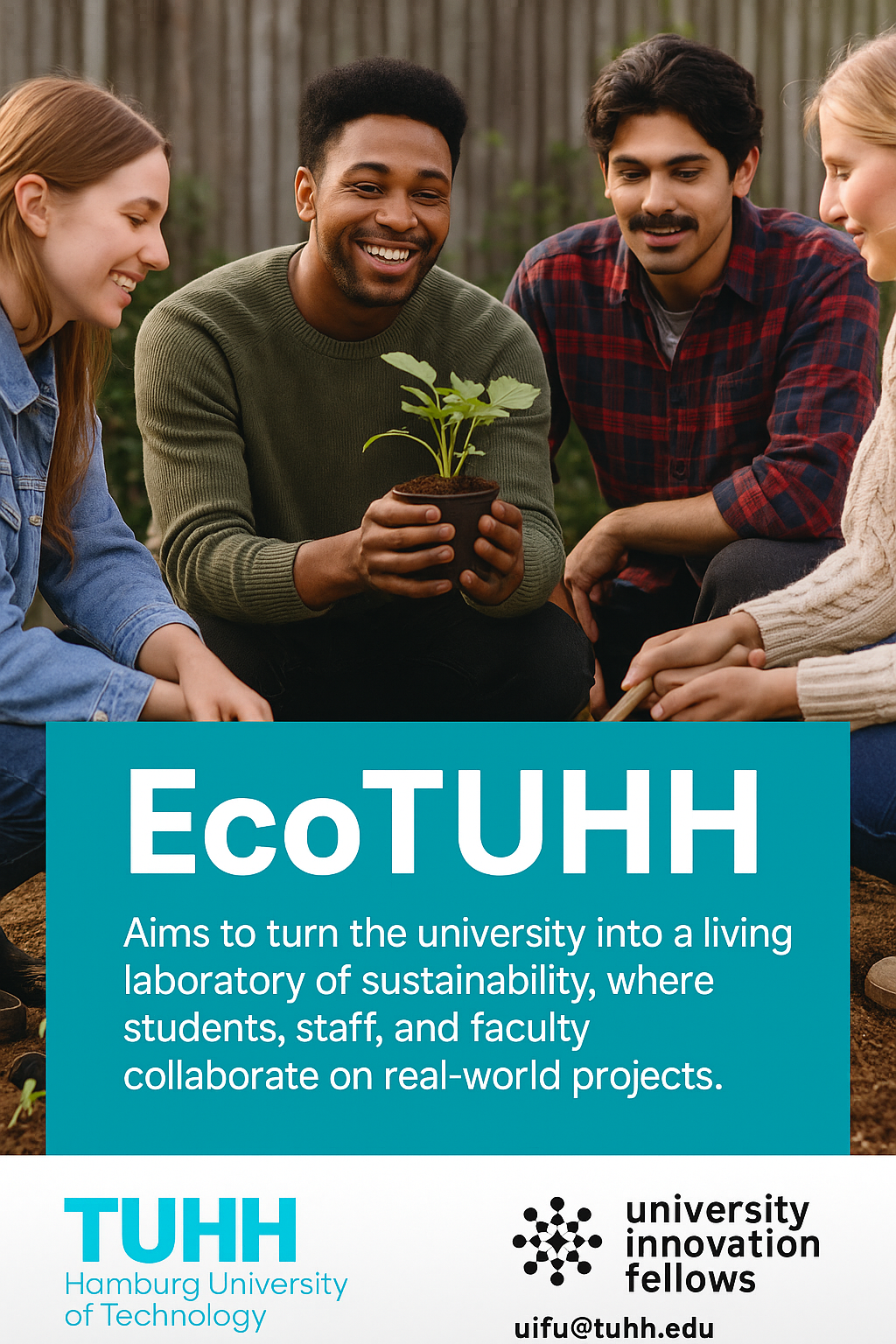
Sustainability has become one of the most defining topics of our timeand TUHH, as a university of technology, is uniquely positioned to lead by example. Across campus, several initiatives already contribute to a greener TUHH: the Mensa’s vegetarian and vegan days, discounts on leftover food, and carbon footprint labels on meals are meaningful steps in encouraging responsible choices. Some previous projects, such as bicycle stand programs and Blue Engineering student initiatives, have also shown how much students care about sustainable living.
Yet, many of these efforts remain isolated, and students often struggle to see how their individual actions connect to the bigger sustainability picture on campus. This is where EcoTUHH steps in.
EcoTUHH envisions the TUHH campus as a living laboratory for sustainability, a place where ideas are not just discussed but experienced, tested, and shared. It aims to empower students, staff, and faculty to collaboratively turn sustainability into visible, everyday practice.
The initiative will bring together existing resources and new student-led projects under one umbrella, from waste-sorting workshops and digital carbon awareness campaigns to eco-challenges, campus gardening, and energy-saving experiments. It encourages learning by doing and creates opportunities for hands-on engagement with real sustainability problems and solutions.
Partnerships with TUHH’s Sustainability Office, Facilities Management, student AGs like Blue Engineering, and city or industry partners will play a central role in making this initiative both practical and scalable.
Ultimately, EcoTUHH aims to cultivate a mindset where sustainability is not a side project or a once-a-year event, but a shared daily habit that defines how the TUHH community learns, works, and lives together. It is a step toward transforming the university into a truly sustainable ecosystem, by the students, for the students, and with the planet in mind.
Strategic priorities
[1] Promote hands-on, student-led sustainability projects (e.g., waste sorting workshops, tree planting, energy audits).
[2] Enhance digital and operational sustainability through automation and paperless systems.
[3] Create awareness and engagement using gamified and social formats like Eco-Challenges or sustainability hackathons.
[4] Build partnerships with the Sustainability Office, city networks, and local industries for real-world collaboration.
Next Steps
[1] Research what sustainability initiatives and partnerships already exist at TUHH.
[2] Develop a motivating project template to help students propose and lead their own eco-projects.
[3] Identify quick-win pilot activities to make the project visible early (e.g., automatic lights or digital dashboards).
[4] Engage key institutional stakeholders to align EcoTUHH with TUHH’s sustainability goals.
Project #3 - Tech-Detox Lock-In
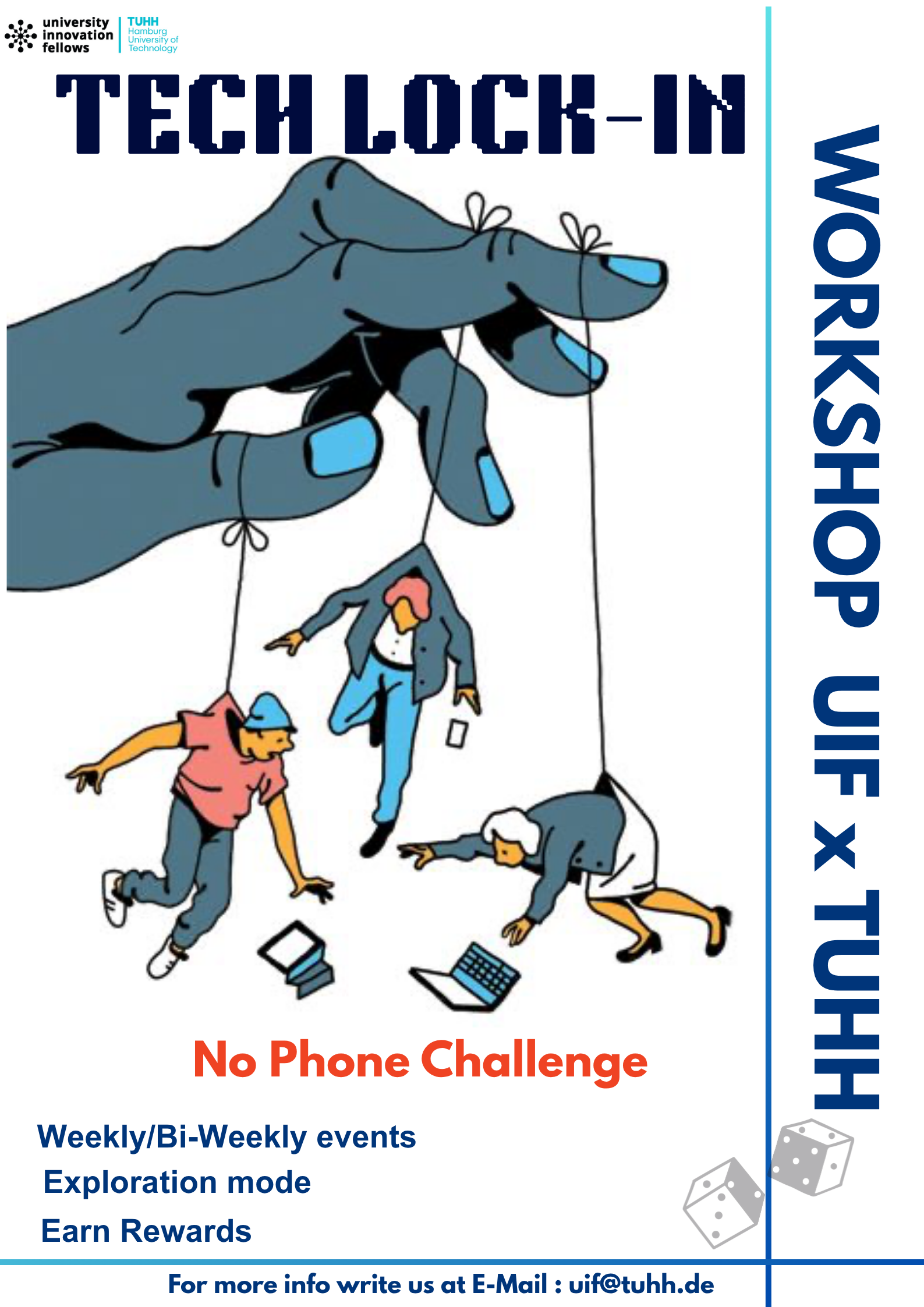
The Tech-Detox Lock-In project is designed to give TUHH students a valuable opportunity to disconnect from digital devices and refocus on personal wellbeing and meaningful social engagement for an entire day. By participating in organized weekly or bi-weekly Tech Detox events, students are encouraged to lock away their phones and gadgets, stepping away from social media and random internet browsing to fully immerse themselves in collaborative hands-on activities, brainstorming sessions, and creative projects with their peers.
This intentional break from digital distractions promotes concentration, supports mental health, and allows for shared reflection where participants can showcase what they have learned or created during the detox—helping students rediscover the power of offline experiences and enabling them to create positive impact within the university community.To keep engagement high, campus-wide reminders and community messaging via posters, WhatsApp groups, and social media will highlight the benefits of digital detoxing, while small rewards like coffee vouchers or snacks will be offered to students who complete full sessions.
Strategic priorities
[1] Creating a device-free environment to foster genuine focus and social connection
[2] Ensuring sustained student participation through engaging activities and positive reinforcement along with rewarding offline activities.
[3] Promote mindful technology use as a campus-wide movement to strengthen student wellbeing and in-person community.
Next Steps
[1] Test engagement strategies like language cafes and advertise in student hotspots (e.g., departments, mensa, newsletters)
[2] Position detox as a flexible tool for digital balance—helping, not restricting, student life.
[3] Collaborate with student bodies and wellbeing offices to scale Tech Lock-In as a recurring, widely embraced initiative.
Project #4 - TUHH Business Games

At TUHH, students often learn about innovation in theory but do not always get the chance to try it out in a fun and relaxed way. Many students feel that events about entrepreneurship or business are too formal or only meant for certain programs. The TUHH Business Games aims to change that by making innovation learning something anyone can join, enjoy, and learn from.
The TUHH Business Games is a playful, hands-on event where students from different backgrounds come together to solve real challenges from companies and the community. In small teams, they brainstorm ideas, build quick concepts, and pitch their solutions at the end of the session. It is about exploring creativity, learning to work with new people, and seeing how ideas can take shape when everyone contributes.
Instead of focusing only on competition, the Business Games focus on collaboration, curiosity, and real experience. Students learn by doing, not by sitting through presentations. The event also gives them a taste of how creative problem-solving works in industry while keeping the atmosphere light and welcoming.
The goal is to build a space where students can experiment, make mistakes, and learn together. Over time, the Business Games can grow into a regular event that brings together students, tutors, and company partners around innovation and teamwork..
Strategic priorities
[1] Make innovation learning approachable through fun, hands-on challenges.
[2] Create collaboration between students from different programs and backgrounds.
[3] Connect student creativity with real industry challenges.
[4] Build continuity by turning the Business Games into a recurring, student-driven event.
Next Steps
[1] Develop simple, engaging game modules that encourage creativity and teamwork.
[2] Get feedback from the University and startup port stakeholders
[3] Partner with companies to bring real problem statements and mentors to the event.
[4] Pilot the event on campus and collect feedback to make improvements for the next iteration.
Cohort Fall 2024
Project #1 - A Platform for Women in STEM at TUHH
Women represent only 35% of the global STEM workforce and just 28% of STEM students at TUHH.
In STEM fields , women often face societal stereotypes, isolation, lack of mentorship, and gender bias in education and the workforce.
This project aims to close the gender gap in STEM at TUHH by creating a platform that fosters a digital and physical community for female students and faculty in STEM. The platform will centralize resources and offer peer-to-peer support, mentorship opportunities, and collaboration to enhance the educational experience for women at TUHH.
The initiative will include offerings such as study groups, chatrooms, networking events, coaching workshops, and inspirational talks. By connecting female students to existing tools and initiatives, the platform will empower them to pursue leadership roles in what is currently a male-dominated environment.
Other universities in Germany, like RWTH Aachen and TU Dortmund, have already developed innovative tools to empower women, such as the CHEFIN project, which supports female students on their path to leadership roles.
Strategic Priorities
[1] Creating a supportive network and community for female students at TUHH
[2] Expanding mentorship and leadership training opportunities
[3] Facilitating community engagement and collaboration
Next Steps
[1] Develop the platform structure with a pilot group of female students
[2] Organize the first series of networking and mentorship events for early 2025
[3] Partner with TUHH Career Center and other local organizations to expand the initiative
Cohort Fall 2023
Project #1 - Innovation Week
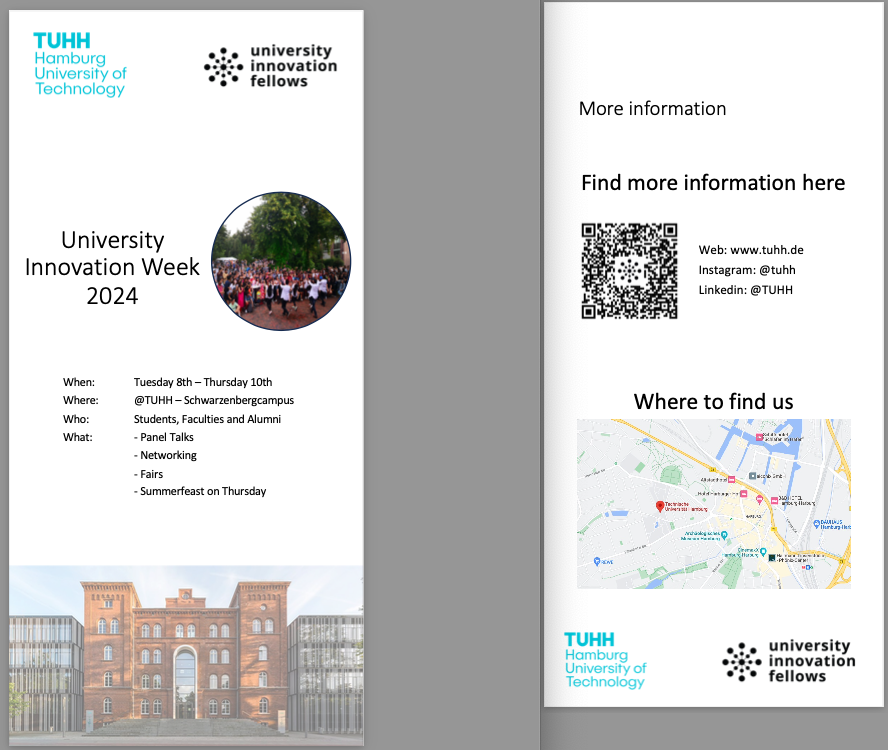
This project seeks to organize a multi-day campus event that encompasses a diverse range of activities. Over the course of these days, students and alumni can look forward to engaging with future lectures, hands-on workshops, and opportunities to connect with the institutes around campus. Additionally, numerous networking events will be available, facilitating connections between students, alumni, and faculty members.
The primary objective of this initiative is to expand students' horizons and foster stronger connections among students, alumni, and faculty. Furthermore, this event provides a unique platform for interdisciplinary interactions, encouraging collaboration and knowledge exchange across different academic disciplines.
Strategic priorities
[1] Strengthening bonds among students, alumni, and faculty
[2] Promoting interdisciplinary encounters
Next Steps
[1] Get feedback from Alumni-Office
[2] Get feedback from the deaneries
Project #2 - Sustainability in Practice
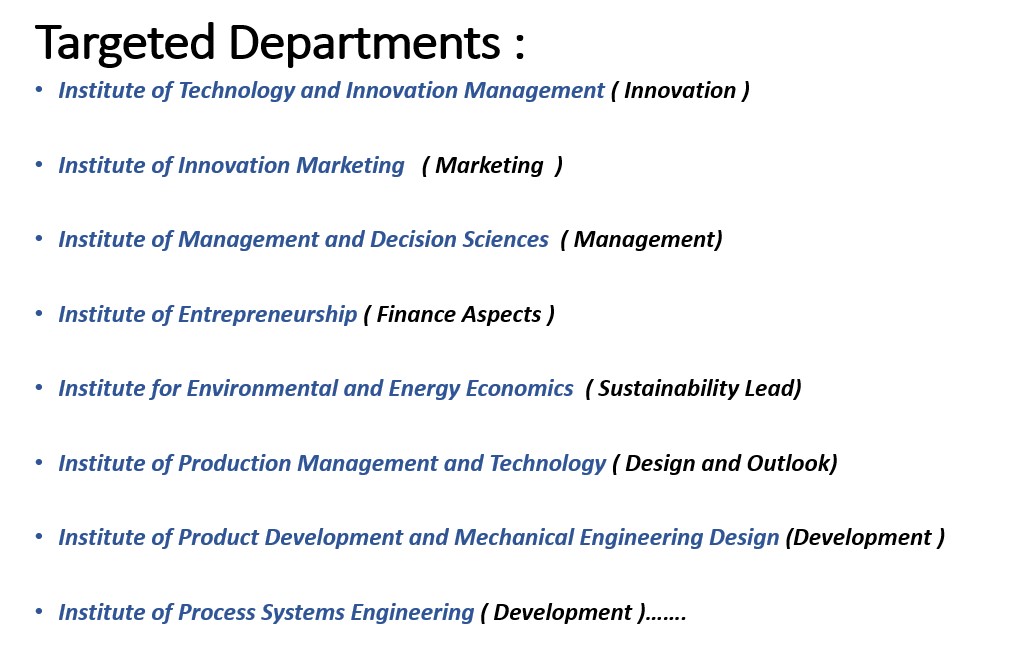
Sustainability in Practice is a dynamic and interdisciplinary course designed to empower students from diverse academic backgrounds to apply sustainability principles in real-world scenarios. In today's globalized world, the concept of sustainability goes far beyond environmental concerns and touches every facet of society, including business, engineering, marketing, law, and more. This course brings together 100 students from various disciplines to work collaboratively in groups of ten, fostering cross-disciplinary understanding, teamwork, and innovation. At least 2 students in each group will be fluent in German to address safety and legal aspects.The main idea is to prepare students to learn to work with people of diverse backgrounds. By involving startups and small companies , the students would get to work in positions of responsibility which would prepare them for being future drivers of innovation and sustainability
Strategic priorities
[1] Better bonding between institutes , students and companies in and around TUHH
[2] Preparing students for future work situations
Next Steps
[1] Get feedback from faculty
[2] Get feedback from start ups and administration
Project #3 - Ideathon
The Ideathon is not just an Innovation Contest; it's a semester-long journey that fosters creativity and sustainability at our university. At the start of the semester, students are presented with a challenge: to conceive innovative ideas that can enhance sustainability within our academic community.
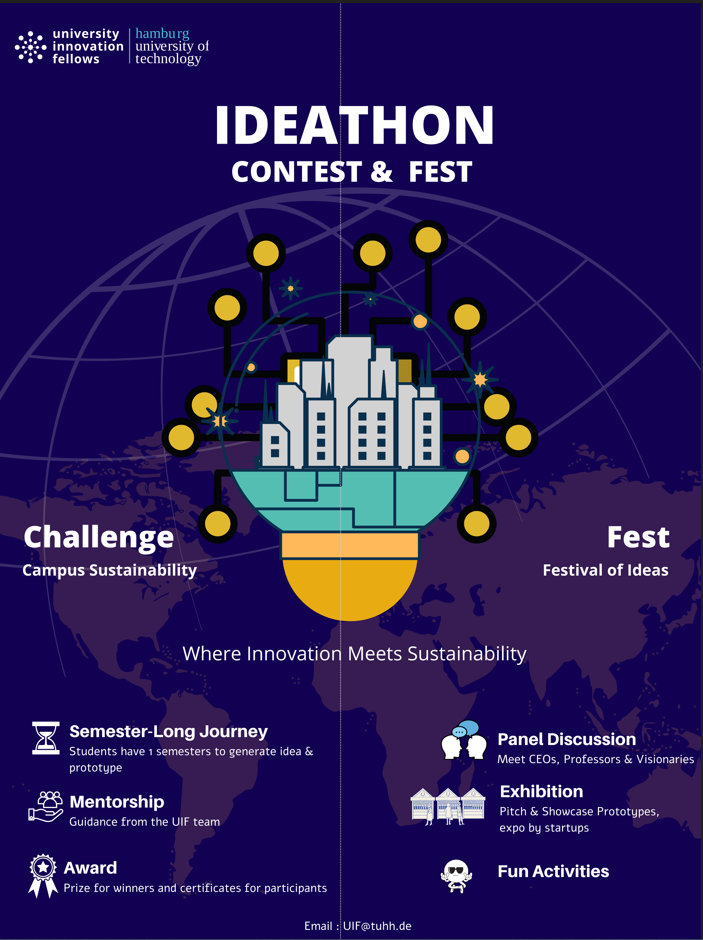
Students form groups and embark on a collective mission to tackle this challenge head-on. They brainstorm, research, and prototype solutions, guided by their passion for creating positive change.
As the semester comes to a close, we celebrate their dedication and ingenuity with a grand finale - the Ideathon Fest. This event is a convergence of excellence, where CEOs from various industries, esteemed Professors specializing in Innovation and Entrepreneurship, members of the University Board, and other influential stakeholders come together to witness the fruits of our students' labor. Attendees can participate in engaging games, listen to inspirational stories shared by accomplished CEOs, participate in enlightening panel discussions, and explore an expo featuring innovative startups.
The highlight of the event is when student groups take the stage to pitch their prototypes. The winning prototype is not just recognized; it's actually implemented within our university, leaving a lasting impact on our sustainability efforts. Moreover, the winning student groups are honored and awarded for their outstanding contributions.
Strategic priorities
[1] Fostering innovation and sustainability in students
[2] Offering interested students practical exposure to UIF and I&E
[3] Networking and Industry engagement
Next Steps
[1] Get feedback from Start up dock
[2] Get feedback from the University board/deaneries
Project #4 - One discipline vs. many – what works better for you and your project?
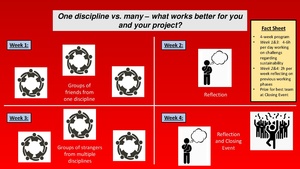
This month-long program allows students to experience the benefits and challenges of working in a team with friends from their own field versus working in a multidisciplinary team with strangers. This enables them to find out for themselves what works better and what should be considered in advance.
Students apply for the program with three or four friends from their field of study. In the first week (work phase 1), these teams work on a task set by a company or an institute at the university on the topic of sustainability. To give the participants some orientation, three workshops will be held on design thinking, prototyping and storytelling. In addition, a person from the company/institute providing the challenge will help students with any questions that arise. At the end of work phase 1, the teams will present their solutions to the challenges in front of a jury consisting of professors, company staff and students.
The second week is all about reflecting on the previous work phase. What has proven successful? Where are missed potentials? What could be done differently next time?
In the third week, the second work phase begins. This time the students are mixed, so they form a team with strangers from other disciplines. The rest is similar to the first work phase. They are given a task and have to develop a solution under guidance. The workshops in the third week focus on the benefits and challenges of interdisciplinarity and other concepts of innovation and entrepreneurship. At the end of the week, again, the group members present their results.
In week four, students are expected to reflect on their work in the interdisciplinary team. At closing of the program, there will be a final event where the institute and industry partners will come together with the students and have interesting inspiring talks/discussions. Finally, the jury will announce the winning group of the competition, which will receive a fabulous prize.
In general, students should be able to dedicate 4-6 hours of work per day during the two work phases. During the reflection weeks, the effort should be 2 hours per week.
Strategic priorities
[1] Have students experience the benefits of working within and outside their own field of study.
[2] Strengthening interdisciplinarity on campus.
[3] Increase awareness/knowledge of innovation and entrepreneurship.
Next Steps
[1] Obtain feedback from university staff.
[2] Contact Startup Port and Fishing for Experience to learn how to build a program.
Cohort Fall 2022
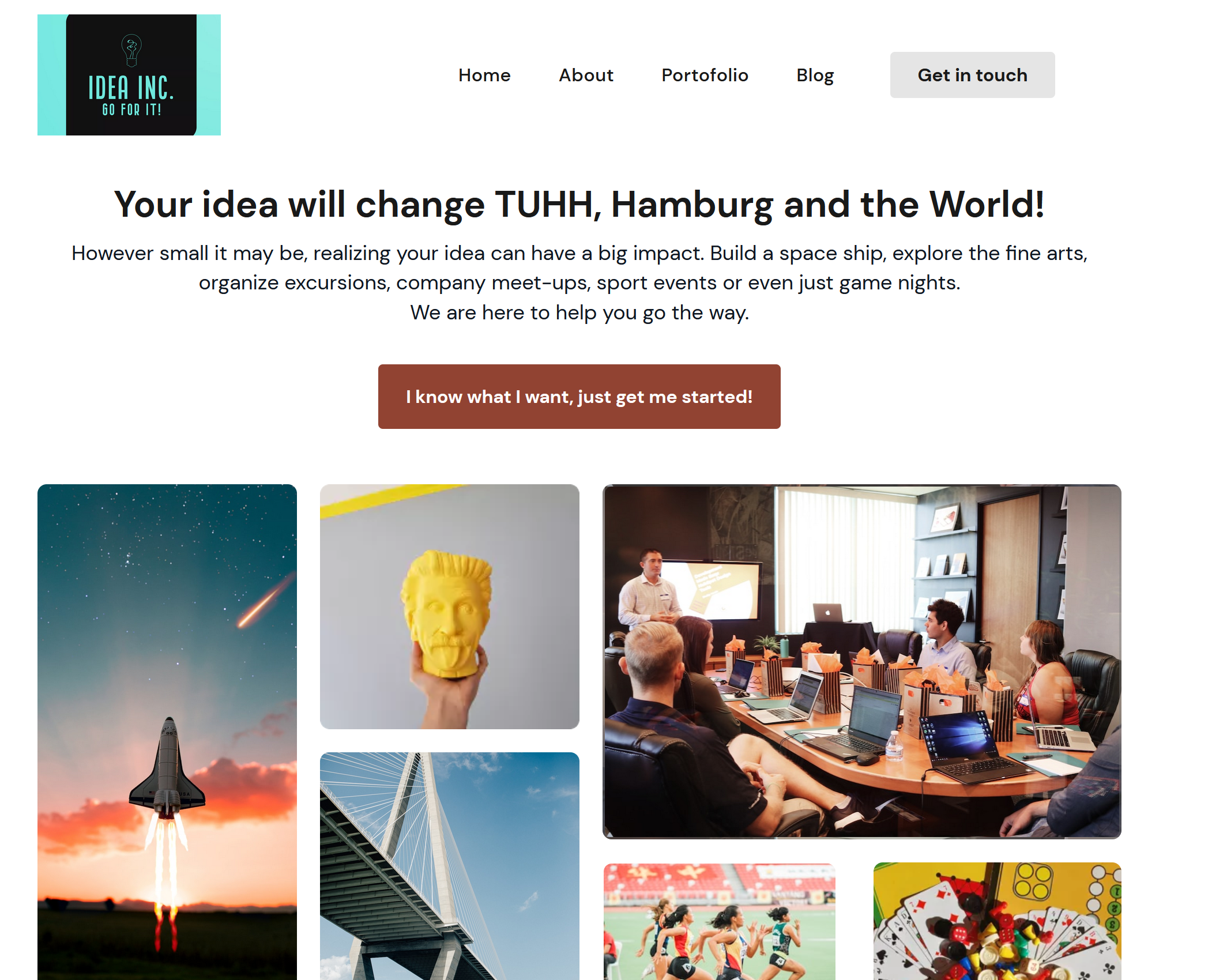
Project #1 - Idea Inc. - The idea incubator

Strategic priorities
[1] Provide a go-to address for projects - support those who want to change something
[2] Provision of training - increase success and survival rate of student initiatives
[3] Accessibility - low-barrier entry for all
[4] Exchange - create new connections, cross-link active community members
Next steps
[1] Feedback from main stakeholder groups
[2] Building of early prototype
[3] Selection of light house project
[4] Stage-gate development of lighthouse idea
[5] Iteration of product based on lighthouse experience
[6] Marketing and launch
Project #2 - T-YOU App
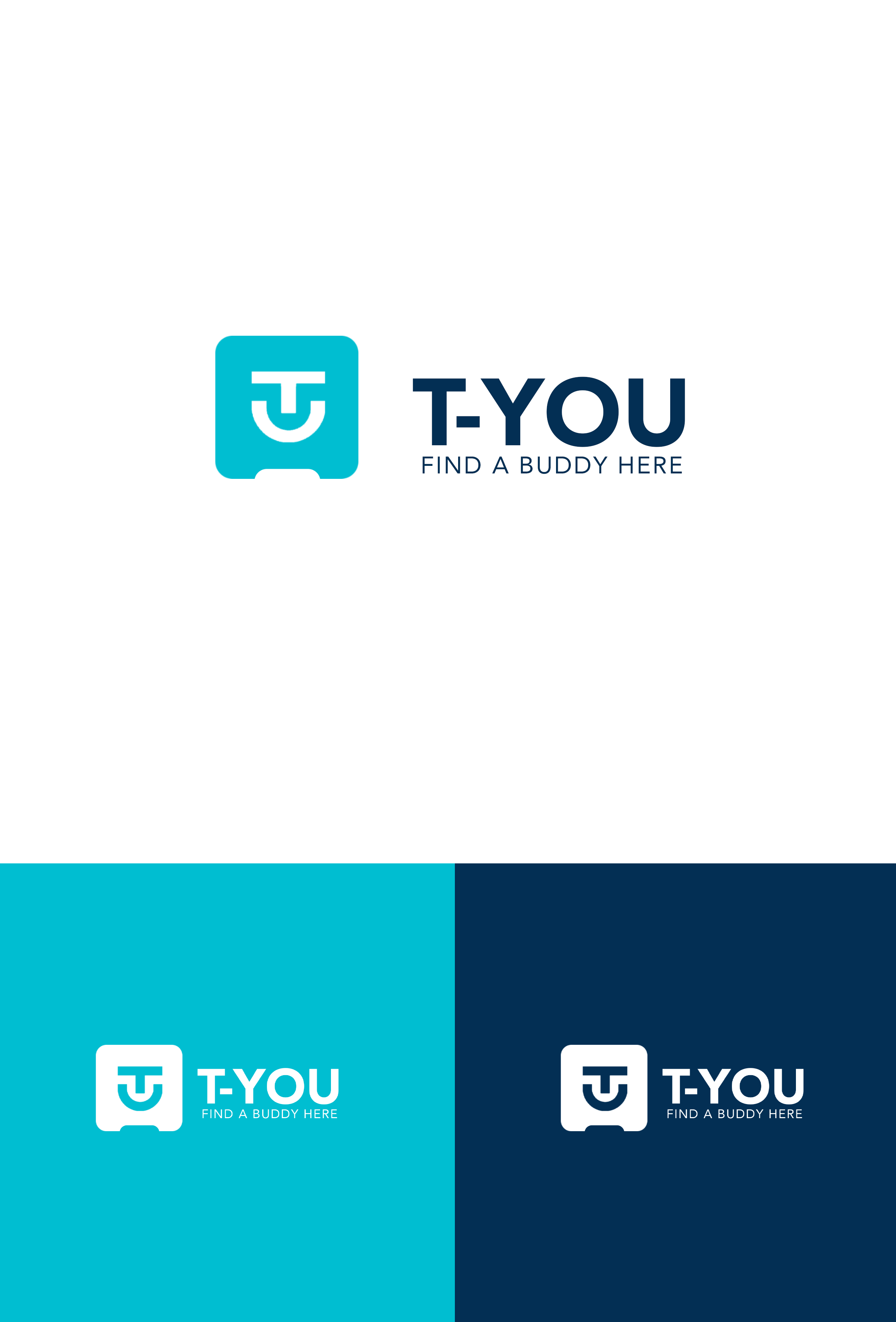

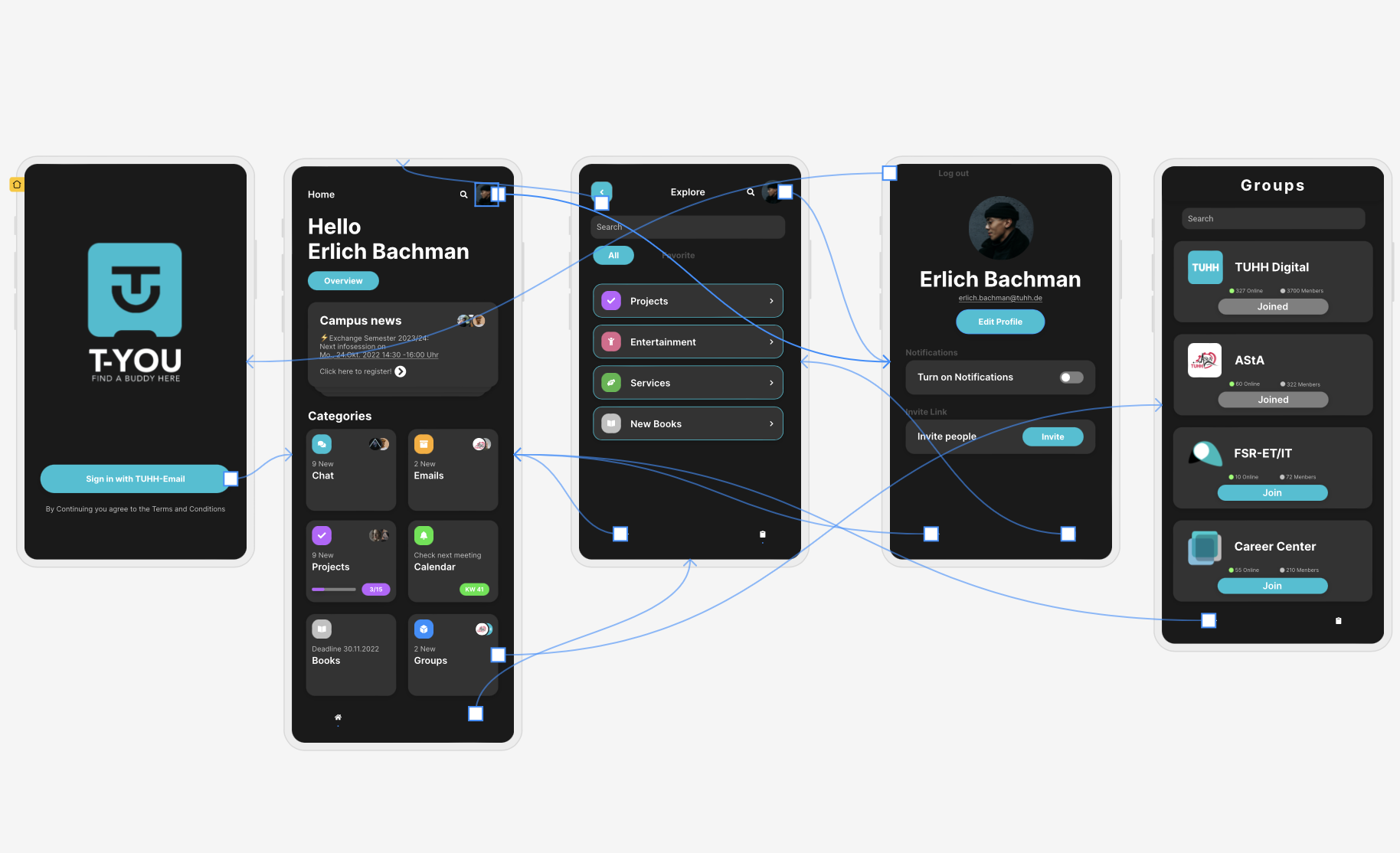
You can check the prototype here: https://app.uizard.io/p/d85bb593
This project aims at facilitating communication around the campus. It brings together almost all websites and platforms of TUHH. By centralising the information, students can hear about what's going on campus very easily, no longer need to check multiple websites and platforms, everything is announced on the app.
By getting students connected to each other and to different entities of the TUHH, this project can also create a community and enhance the sense of belonging among students. Different sections are made to encourage students to exchange services or information, work together on projects or get to know each other and hang out together. One of the key characteristics of this app is that it's exclusive to TUHH students, which will help create this community.
Strategic priorities
[1] Sense of Community - enhance the feeling of belonging among students
[2] Communication - facilitate communication between students and different entities of the university
[3] Accessibility - You only need a smartphone and your TUHH email to be part of this app
[4] Exchange - encourage students to exchange ideas, information or services.
Next steps
[1] Get students' feedback
[2] Clear and precise Prototype
[3] Discuss it with the stakeholders
[4] Funding
[5] Development
Project #3 - Innovation Summer School - Elbinnovate

You can check the prototype here: https://play.teleporthq.io/projects/marketing-event-page-ta2wra
By clicking on the "Play" button in the upper right corner you can go into preview mode and visit the lending page.
The idea behind this project is to encourage and enable students to get together and initiate the work on projects that matter to them. Within this summer school event we aim at (1) teaching them the importance and the toolsets of Design Thinking as well as Entrepreneurship and (2) show to them how they can combine these tools with their unique technical expertise acquired through the study programs of TUHH in order to work on real-life problems and applications. This way we believe that we can enhance the capability of self-organization and the initiative to pursue own ideas. Potentially in collaboration with industry partners, the students may approach them for guidance and the possibility to work on industry related projects to enhance and apply their knowledge to challenging real-world applications. It is further intended that the Elbinnovate won't be a stand-alone summer school event, but rather acts as an incubator and kick-off event for students to work further on ideas and projects that matter to them. That way it will have a lasting impact far beyond the workshop days of the summer school itself.
Strategic priorities
[1] Sense of Community - bring students together and motivate them to pursue own ideas
[2] Communication - enhance communication between students, industry partners and lecturers
[3] Accessibility - every TUHH students (and potentially alumni) may participate in the Innovation Summer School
[4] Exchange - enable students to get together, discuss topics that matter to them, bring them closer to industry partners
Next steps
[1] Feedback from students, stakeholders (i.e. motivational speakers, lecturers, industry partners, TUHH administration etc.)
[2] Elaborate further on the contents and outline the workshops
[3] Get a location, a framework, the tools to conduct such event
[4] Funding capabilities
[5] Exchange with potential lecturers and speakers on the individual workshops
[6] Plan the dates
Project #4 - Tech Fests
Strategic Priorities
[1] Awareness - Advertise the program to Encourage students to come forward to participate .
[2] Communication - Bringing students of Various departments to come close and form a Network.
[3] Accessibility - All TUHH students can participate .
[4] Exchange - Providing a platform for students to explore their innovation and creative minds.
Next Steps
[1] Get students and Professors feedback.
[2] Talk with Stake holders .
[3] Draft a plan involving industries, Professors and students.
[4] Sponsors : We would require a lot of Funding .
[5] Expand our program among Different Universities.
Cohort Fall 2021
Project #1 - TUHH Pocast
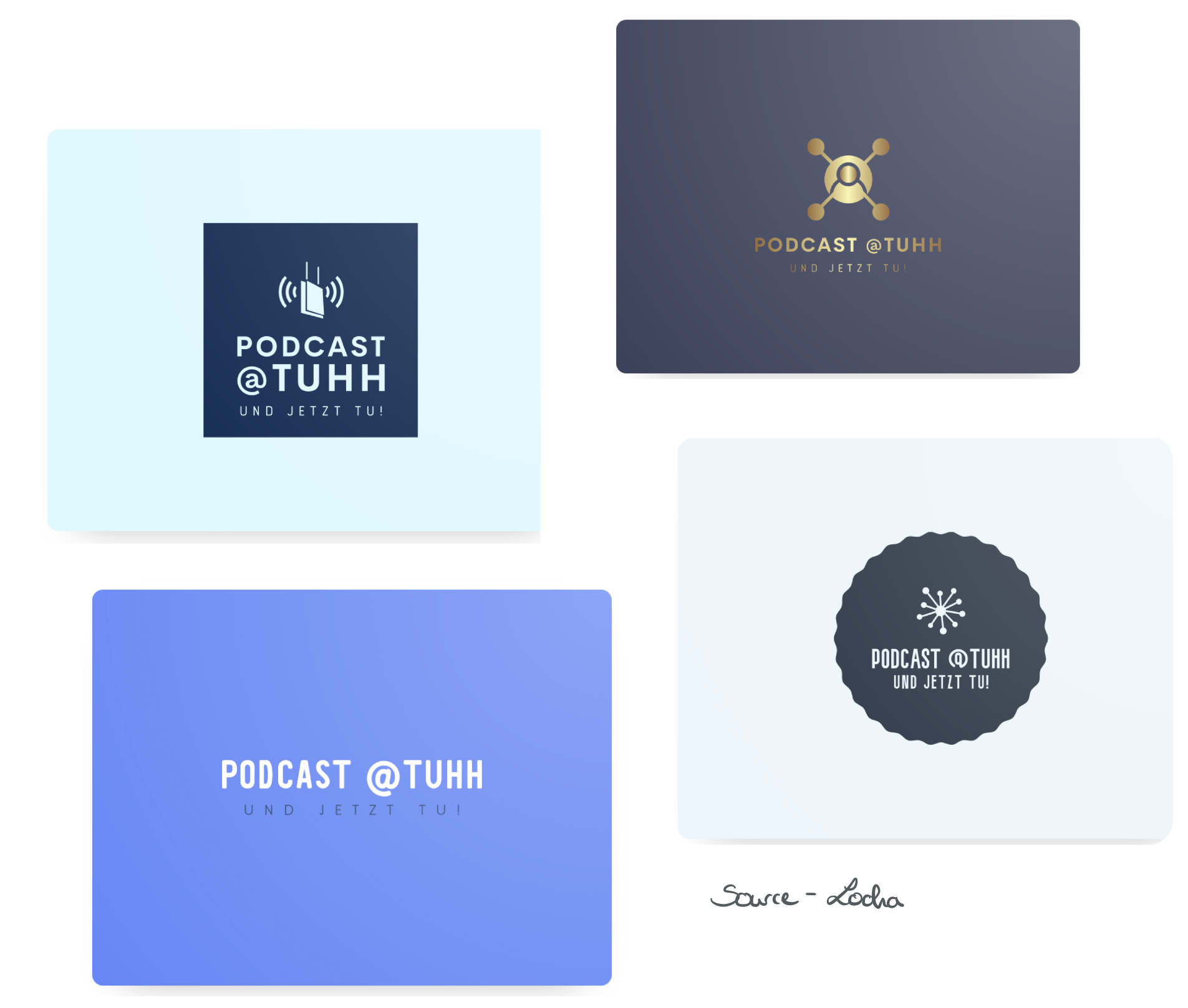
As a student you learn way too late about what opportunities exits at our university. The awareness about student projects, startup possibilities or even university internal innovation projects is not raised enough, that the average student at our university knows about it. Some students don‘t even know about the Startup Dock at TUHH, which supports founders in their early stages. During our research we discovered the Podcast „Trial & Error“ by the Startup Dock. Therefore we thought a PODCAST @ TUHH would be an amazing tool to raise awareness about what projects already exist at our university. This format should not be limited to only innovation and entrepreneurship, but also cover students groups, international students, guests from companies, startups and even professors talking about their newest research. A podcast first of all creates awareness about projects at our university and secondly creates a platform and network of the podcast team and invited guests. Further ideas to make our PODCAST @ TUHH even more special are: live audience or livestreamed podcast, special guests, a newsletter, and Reels on Instagram to inform students about the newest episode.
Strategic priorities
[1] Create Awareness - make the TUHH transparent for everyone
[2] Community – bring students, startups, companies, student groups and professors closer
[3] Promotion of ideas, innovation, founding and research
Next steps
[1] Gather students feedback: topics, guest, length, how often an episode
[2] Make list of ideas about podcast structure and guests
[3] Meet with Laura Steinau – Online reporter for Trail & Error
[4] Talk with stakeholders
[5] Find out about existing resources for podcast equipment
Project #2 - APP: YIC (Your Idea Counts.)
Info about the project / the general concept
_TUHH_Cohort_2021.png)
Screen Description: After the application is started on any mobile phone, the start screen is shown next. (left side) It shows the title of the app and tries to communicate that everyone with an idea can use it. All ideas are welcome for reflection. After that the user is presented with the main screen of the app (right side on both images). Here, one can see all posts created by the people using this app. By default, it shows most popular posts on top, but they can also be ranked by other criteria. These categories can be: region, organisation, time, alphabet, collaboration interest, etc.. Popularity of a post is measured by the number of likes or dislike it gets. Interest in controversial discussion or collaboration could be measured by the number and type of comments under a post. Every entry can be hidden and with that removed from the list.
_TUHH_Cohort_2021_2.png)
Screen Description: The first screen shows how it could possibly look like when people open a post (left side). For simplicity, it is intended that posts only consist of max. one image a short description and maybe a link for more information. A post can be rated by likes or dislikes. As the app is there to create a community with connections as a network of entrepreneurial and innovative people, it is possible to link the LikedIn profile with the YIC app. Every post is tagged with the name and contact information of the person who created it.
We want to start with the following steps:
Next steps
[1] Demand inquiry: To find out if there is a real demand we want to build a test product and create a small study if people would seriously use the app.
[2] Sponsoring: Even if it's as simple as this one, a lot of recourses are necessary for the creation and maintenance of an app like this. Therefore, huge financial help is needed to carry out the project.
[3] Development: The development of the app is the central part of bringing the product to the students and other people who might contribute to the app.
[4] Advertisement: To reach a huge community and make people actually use is, it is of important relevance to start off with strong advertisement for our product. With this strategy we are able to create a waterfall which reaches not only people from TUHH, but also other communities from the city, the entire country or even get an international standing in a best case scenario.
[4] Feedback, Conclusion, Improvement: By gathering feedback on the user experience of the app or starting a (regular) survey it is possible to measure the impact of our product over time and classify how well it has been adapted by real life users, students or other I&E interested people.
The following points are our strategic priorities with this project:
Strategic priorities
[1] Development Power: The mobile app as the central point of the product must be developed and maintained during the process. For this we need a lot of professional (voluntary?) man power.
[2] Funding: The development of the app, maintenance as well as advertisement costs a lot of money. Therefore, it is necessary to find sponsors or investors that believe in the app idea. ...possibly in exchange for a good standing?
[3] Advertisement: To get the people's attention advertisement can not be avoided. This is essential to get the potential user's attention. For this it is advantageous to use already existing channels at university as a start point.
[4] Point out App benefits: Make sure the user can easily realise what value and benefits he:she has by using the app and highlight it, e.g. when advertising.
[5] Steady content: make sure that the app doesn't go to sleep and is fed with continuous content to keep the users in the app and revisit it regularly, because the stable flow of more and more innovative ideas is what makes it what creates the inspiration and therefore benefit for the user.
Project #3 - TUHH Innovation Days

This project also relates to the awareness issue at our university. Many students don't know about already existing opportunities at the TUHH. This two-day event would give each orgnization exposure and a setting to connect with students, that are interested in founding. The event should be a mixture talks, in which organizations like the Startup Port and the different maker spaces introduce themselves to students. Additionally, the event includes workshops for both students and faculty, where they can interact with each other and also learn about things like Design Thinking or Rapid Prototyping.
The following points are our strategic priorities with this project:
Strategic priorities
[1] Timeframe Select a timeframe that doesn't compete with important curricular events (lectures, exams etc.)
[2] Awareness work out an advertising strategy to get the word out to people
[3] Support get as much support as possible during stakeholder meeting (strategic and financial)
Cohort Fall 2020
Project #1 - TUHH Ideenschmiede
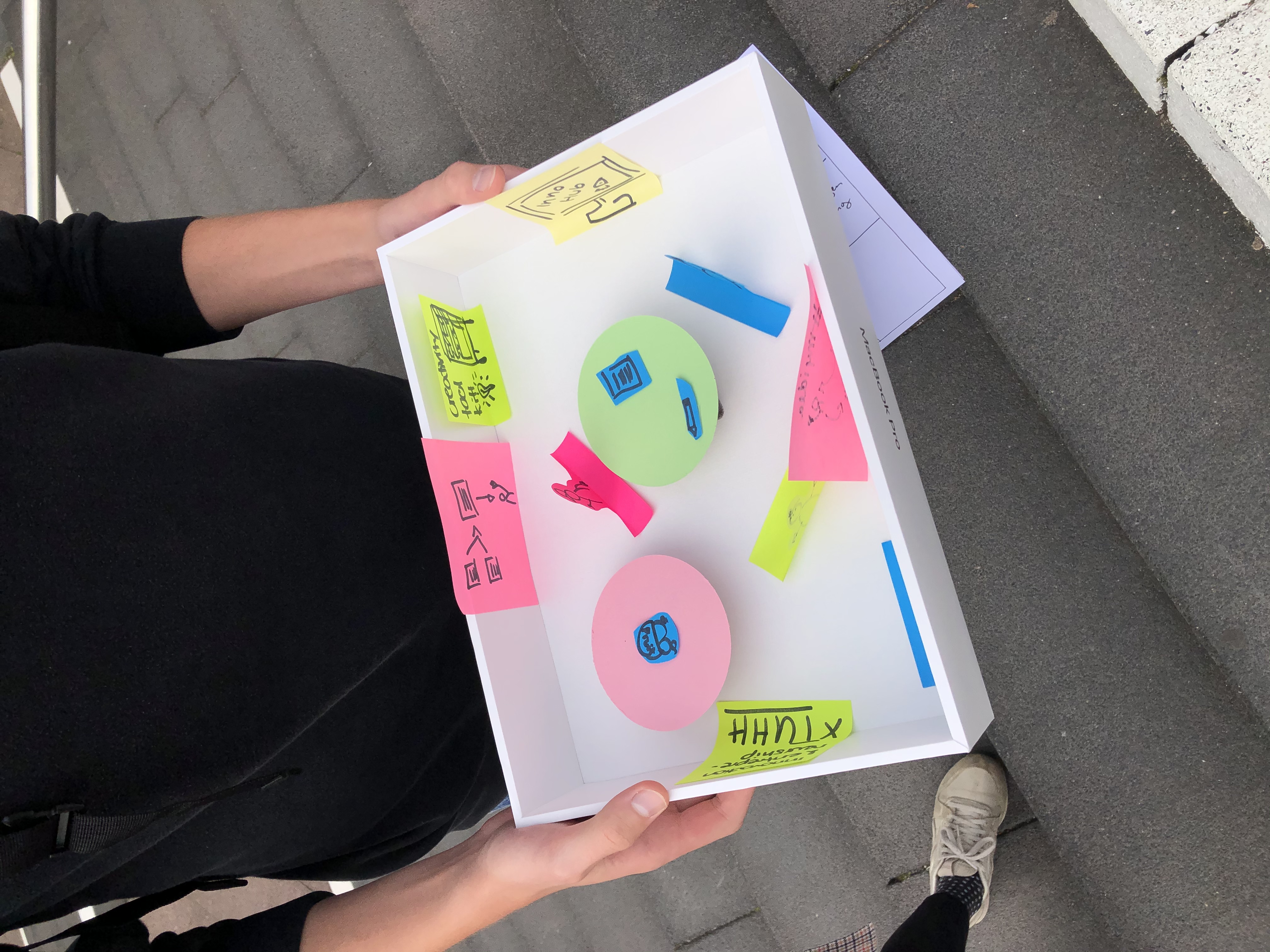
When students at the TUHH have a startup idea, already gathered a team around them and know in which direction the startup should develop, there are institutions in place, which they can turn to for help (Startup Dock, TuTech, Institute of Entrepreneurship, etc.). However, there is currently no infrastructure at the TUHH for students to pitch their ideas, ask for & receive feedback, brainstorm or get in contact with people who are looking for team members on their startup team. Thus, a creative space for students to connect, exchange and discuss innovative ideas is currently missing. In order to overcome this problem, we want to develop a physical space for students (in long-term) to connect.
TUHH Ideenschmiede will be a virtual and physical space for students to come together, discuss ideas, brainstorm or host I&E events to inspire others. This space should be available to all TUHH students to visit and should be organised by students (in cooperation with a professor). An example for such a space is of course the DesignLab at the University of Twente. The TUHH Ideenschmiede will make the topic of Innovation and Entrepreneurship accessible to all TUHH students and thus, will expand the students' horizon.
However, since building a space requires a lot of resources, we want to start with the following steps:
Next steps
[1] Demand inquiry: Develop, send out & evaluate a questionnaire for students to identify needs for a virtual & physical exchange space
[2] Development & test: Develop a regular ZOOM format to exchange ideas & test
[3] Regular operation: Offer regular ZOOM meetings; plan & gather things required for a "ambulant" creativity space
[4] Prototype & Test: Start offering a "ambulant" Creativity Space on campus, e.g. Ideenschmiede Lunch Dates etc.
[5] Implementation: Raise money & build physical space for TUHH Ideenschmiede (this is a long-term goal)
Our main goal with this space in long-term is to become a creative meeting point at the TUHH for students to get in contact with the topic of I&E, especially for bachelor students. The objective with the current list of next steps is to first test the idea, get an overview of the students wishes and needs and have an evidence to show the investors that such a place is required at TUHH.
The following points are our strategic priorities with this project:
Strategic priorities
[1] Broaden the horizon Connect students with different interests and fields of studies
[2] Be creative Inspire students to work and think differently
[3] Build a community Build a network of I&E experts at the TUHH
[4] Be part of the change Enable students to crate change at the TUHH but also in their personal life
Project #2 - Week of Interests

Students of the TUHH don't have much time besides their studies to discover and pursue new interests. To address this, the "Week of Interests" makes it possible for participants to attend (curricular and extra-curricular) courses that differ from their regular field of study. This includes courses from all kind of degrees at different universities.
Strategic priorities
[1] Interdisciplinarity: aim for as much variety in courses as possible
[2] Integration: try not to compete with curricular lectures/exams and enable students to get insights into regular courses
[3] Connection: enable students to connect with people from different fields of study/interest
Next Steps
[1] Select a time frame that doesn't compete with important curricular events (lectures, exams etc.) - this could be done with a questionnaire for students
[2] Connect to schools, training staff, teachers etc. (different Universities would be great) - ask them if they would allow a few extra people in their courses - aim for variety
[3] Create a portal on which trainers and staff can add time, place, allowed number of people etc.
[4] Inform students about offerings - start with registration
[5] get feedback, add new courses etc.
Project #3 - Design Thinking Week
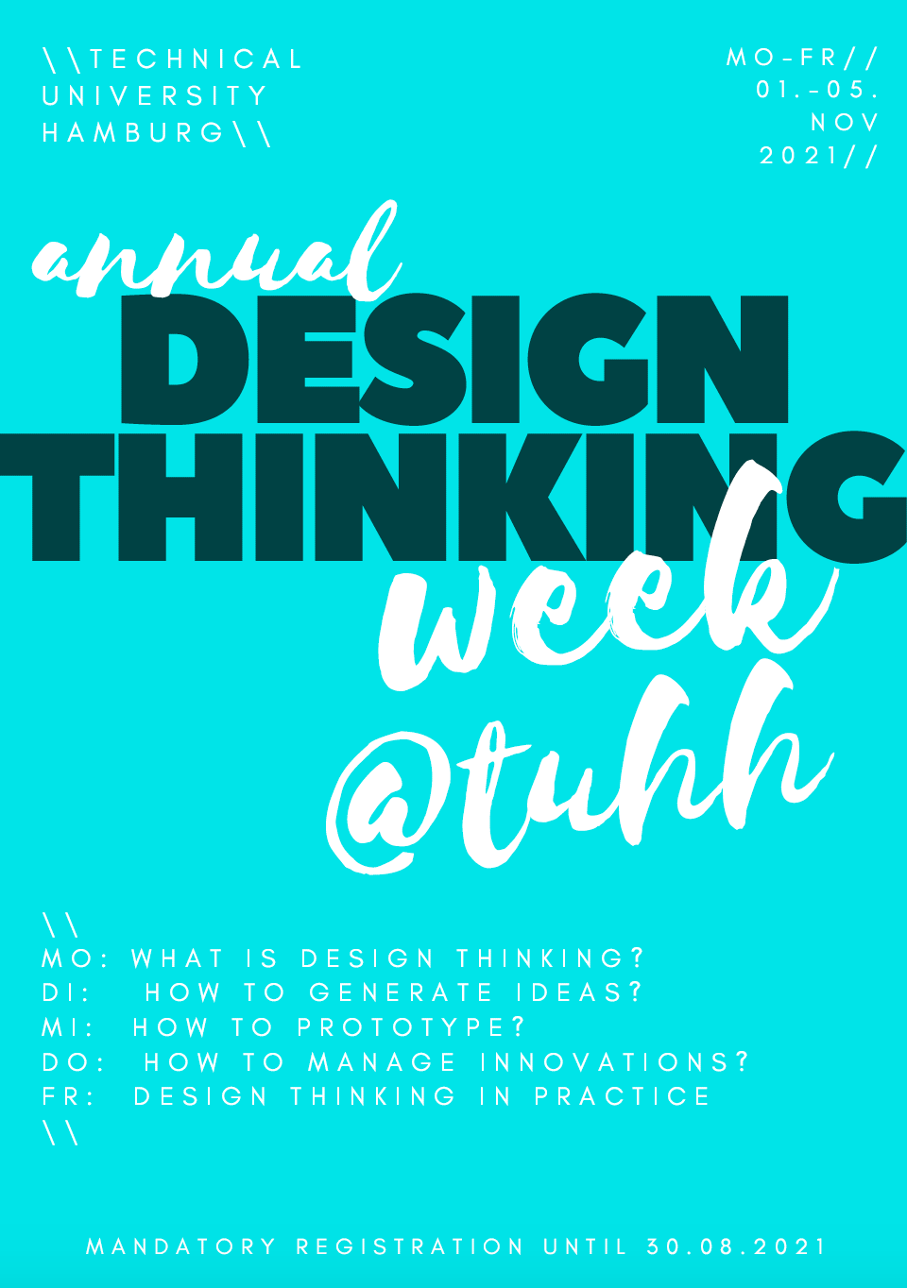
Students of the TUHH, especially in during the bachelors degree, have very limited opportunity of taking courses that teach about entrepreneurship and Innovation (one mandatory course in "general business" - very broad). Design thinking is a creative process of problem solving. Especially at technical university like the Technical University of Hamburg it is important to not to take away the creativity of the students as all the courses are very theoretical and strict. Therefore, e.g. learning the design thinking method in a "design thinking week @tuhh" every year organized for all newcomers at TUHH would be a good solution to develop a innovation mindset right from the start.
The Design Thinking Week @TUHH The presents of professional speakers gives the newcomer students @TUHH the opportunity to dive in into the process of design thinking - a creative way of problem solving - and learn how to use this popular and effective method in their daily- and work-life.
Content:
What is design thinking?
The students get an introduction in the design thinking process learning the basics and the background.
How to generate ideas?
The students get to know the whole ideation process and learn how to generate ideas.
How to prototype?
A prototype is used to make the idea tangible and opens up the possibility of feedback and refine. There are different ways how to prototype ideas, which will be explained to the students.
How to manage innovations?
This is a broad topic and will be filled by the responsible speaker. All in all, the genreal handling of innovations should be taught.
Design thinking in practice.
In the last part the students are instructed to run through a design thinking process by way of a given example.
Strategic Priorities
[1] Professional Education
[2] Development of Innovative Mindset
[3] Socialization - Community Thought
Next Steps
[1] convincing the change maker and administrative staff @tuhh
[2] research and request appropriate speaker
[3] make room for the week in schedule
Project #4 - University Innovation Day
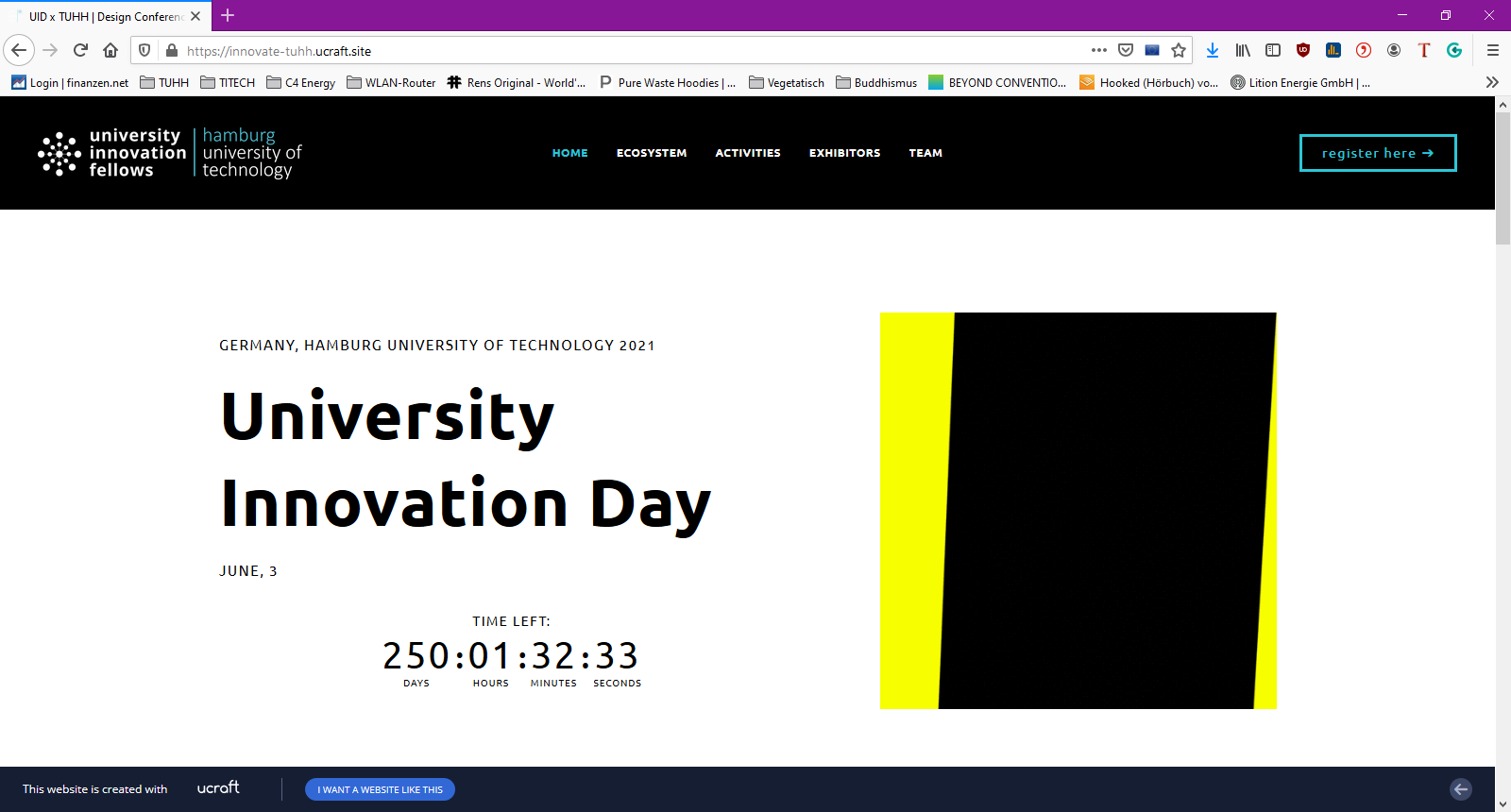
During the research on TUHH's landscape canvas, our team realized how cumbersome it is for students to identify all of the relevant resources that are supposed to support them on their journey to becoming an entrepreneur. Some of the information is not even available on the internet. Hence, we figured that students are missing information regarding TUHH innovation ecosystem. This includes the following pieces of information:
- Students barely know what kind of innovative research projects the institutes are currently working on
- Students barely know what innovative activities TUHH is supporting in the region
- Students barely know which startups emerged from TUHH
- Students barely know what kind of entrepreneurship classes exist
- Students barely know about innovation hubs at TUHH or in the region
Consequently, University Innovation Day (UID) was prototyped which is an annual innovation fair aimed at letting students experience all aspects of TUHH's innovation ecosystem. Hereby, we want to provide useful information on all steps of the entrepreneurial journey which begins with getting inspired to innovate and ends with successfully launching a company. This implies that all students and other guests are invited to join the UID, regardless of which phase of the entrepreneurial process they are in. One the one hand, UID visitors learn more about TUHH's innovation landscape by strolling around between fair-type booths. On the other hand, they are given the opportunity to actively gain insights by participating in workshops. Simultaneously, the relevant information is permanently made available on a website.
This website served as a fake door prototype. It entails the homescreen and several secondary pages. The "innovation ecosystem" page gives information on TUHH's landscape canvas. The "activities" page contains the schedule of the workshops which are offered at UID. Pop-Up classes give entrepreneurship beginners insights on what TUHH's innovation courses have to offer. A design competition gives more experienced students the opportunity to tackle a challenge by applying design thinking. The founder speed dating gives students with a business idea the possibility to elevator pitch and find collaborators. The "exhibitors" page gives more detailed information on the innovation ecosystem stakeholders.

TUHH Innovation Ecosystem
UID Activities
Pop-Up Classes
Design Challenge
Founder Speed Dating
UID Exhibitors


Testing the first prototype revealed that only giving information about TUHH's innovation system at UID is not interesting enough for the students. Instead they appreciate opportunities to learn, connect and exchange thoughts. Accordingly, most testers stated that the best part of the UID are the offered workshops. Hence, we need to focus on making the information about each part of the innovation ecosystem accessible in a more playful manner.
However, since developing different kinds of workshops and games requires a lot of effort, we want to start with the following steps:
Next steps
[1] Develop prototype V2: Develop an interactive landscape canvas graphic for the website and design workshops of different difficulty levels for every part of the landscape canvas (discover, learn, experiment, pursue, spin out). Rearrange the website according to the entrepreneurial journey.
[2] Second Test: Conduct a second testing session checking for assumption verification and potential demand.
[3] Curriculum integration: Approach the faculty and check for the possibility to acknowledge higher difficulty workshops as elective course with respective gain of credit points.
[4] Consider online alternative: Ideate an online version of UID, in case it cannot take place on campus due to the corona virus.
[5] Attract collaborators: Find further members for the organizing team. Executing the current plan will not be possible with a team of four.
[6] Establish a brand: Design a brand that can be trusted and students can identify with.
[7] Reach out to exhibitors: Develop relatioships to potential exhibitors at the fair.
[8] Implementation: Raise funding, get date confirmation, develop detailed spatial concept, block spaces for workshops, etc.
Our main goal is to make students aware of what amazing opportunities we have at TUHH. By making them familiar with the university's innovation system, we hope to inspire and motivate them to engage more in innovation processes. As a consequence, the UID would evolve to an annual celebration of TUHH's entrepreneurial culture.
The following points are our strategic priorities with this project:
Strategic priorities
[1] Empower students to engage in innovation: Make students aware of the opportunities to innovate and the support they can receive
[2] Promote TUHH's innovative endeavors: Give TUHH's members a platform to promote their innovative projects
[3] Celebrate entrepreneurial culture Inspire TUHH's members to innovate and reward active innovators
[4] Connect innovative minds Build a network of I&E enthusiasts, let them exchange thoughts and support founding team formation
Cohort Fall 2019
Campus Overview
The Technical University of Hamburg is a relatively young and small university. Since it is a technical university most of the departments are engineering related but there are also some management and business related one. The strategiv priorities defined by the administration of the university are:
[1] a research focused on innovation
[2] foster entrepreneurship
[3] be a family friendly and inclusive university
Especially the first two points are interesting regarding our findings during the UIF training. As we interviewed students and ste up our landscape canvas we discovered several problems that are somehow related to the strategic priorities of the universiy. First, there is a lack of communication. This means that there actually a lot of possibilities to support students in their entrepreneurial desires, but students do not know about them because there are communicated inefficiently nad, furthermore, there are not connected to each other nnd therefore not operating as a network. Our second finding is even more severe and fundamental in our opinion: There is no real connection betwenn students and our university, meaning they are not really engaging in all the things the university offers. This, besides a few other reasons, leads to a missing entrepreurial mindset - our university teaches students to be mangagers and engineers, not entrepreneurs and therefor is clearly missing its second strategic priority.
To encouter this set up our own strategiv priorities, which are relevant to all the projects following below:
[1] We want to create and foster a community feeling / spirit and try to get students enganged
[2] We want to foster students motivation to deal with entrepreneurial matters and eventually motivate them to become entrepreurs
During our journey we discovered similar problems as the first cohort last year. This shows that the found problems are relavant and are not tackled yet. This also leads to the fact that some of our projects turned out quite similar to last years projects after a few iteration steps. Thas why we also consulted last years fellows for feedback on why specific ideas do not have pursued further to gain additional insights.
Project #1 - TU App (bringing things together)
The first project started as an 3-day entrepreneurial event. The prototype was an illustration where students could choose different ways on how the event should be organised. During the iteration it became clear that one central element, a platform where students can share ideas and form teams, were found best. So the follwing iteration step focused on this platform. During the test of the next prototype it became clear that an application would not suit an one-time event. It has to be more general to create a larger userbase. After some refining and one more iteration the final project was born:
The TU App! This app should work as an aggregator and bring together all, or at least most, of the information which is already available at our campus. First all the things which students use on a regaluar basis have to be integrated to create the necessary traction and retention and create a userbase: for example grade and course overview, information about available thesis topics etc. In a next step function to foster entrepreneurship can be included: for exmaple a forum for ideation and team formation, information abour available maker spaces etc.
The app could basically look like this:
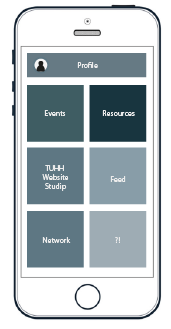
As mentioned above the app should include the following functions in two steps:
Step 1: (create usefullness for students, communication is key)
- daily used sites regarding students life on campus: elearning platform, grades and course list, webmail
- institutes new and available topics for thesis
- free rooms for learning
Step 2: (foster entrepreneurship)
- forum for ideation and team formation
- avalibale workspace for prototyping
- information about projects, competitions and workshops
Strategic priorities
The most important point to make this project happen is its strategic positioning. The app has to be positioned as something the adminsitration desires, since it is going to help them to reach thier goal to be an entrepreurial university. It does not satify a need of students, since the students do not have a need because they do not know (yet) what they are missing.
[1] Communication - We want to create an easy and convinient way to spread and gather information about everything which is going on on our campus
[2] Community - Creating a space were all members of the university coem to gather and exchange ideas and information as the first step to create a feeling of community
[3] Connectivity - We want to boost collaboration and bring together all teh already availible offers which help students to become entrepreneurs
[4] Transparency - We want to make all information accessible for everyone
Next steps
[1] Elaborate and refine the idea with university stakeholders
[2] Build and test a MVP to profe feasibility
[3] Set up a cost plan and a business case
[4] Secure funding and the continuesly development of the app
[5] Develop a role out plan to bring the app to the campus
[6] Transfer the app into a routine for any memebr of the university
.
Project #2 - The Change Project
Students often lack time due to a tight schedule so that they have less time for activities that foster the university community. Often extrinsic motivations e.g. credits or bonus points improving the grade are motivators for students to enter an unknown environment. In our interviews we realized that the buzzwords "innovation" and "entrepreneurship" are ridiculed by some students focusing on technical studies. Taking the plunge into the unknown (projects focussing on innovative/entrepreneurial procedures) has to be supported bonus points or/and credits in the beginning.
The idea has derived from the thought to offer a non-technical course (called NTA) enabling students to work on the projects students are interested in. The projects should be problem-based (e.g. problems at TUHH, environmental/social problems,...). The problem solving process is supported by innovative/entrepreneurial methods. Therefore a short training session is important. Due to administration constraints, the project topic can only change on a yearly basis. Furthermore, the final idea considers the inclusion of institutes and course content. A network of insitutional staff and administration supports the students by assisting them. Further students participating related courses get bonus points to take pressure from the students participating actively in the course.
The final idea is a mixture of
- a course in which students can work on problems by using innovative/entrepreneurial methods,
- get input from related courses, and if possible
- the assistance from institutes / companies.
Non-technical course creation
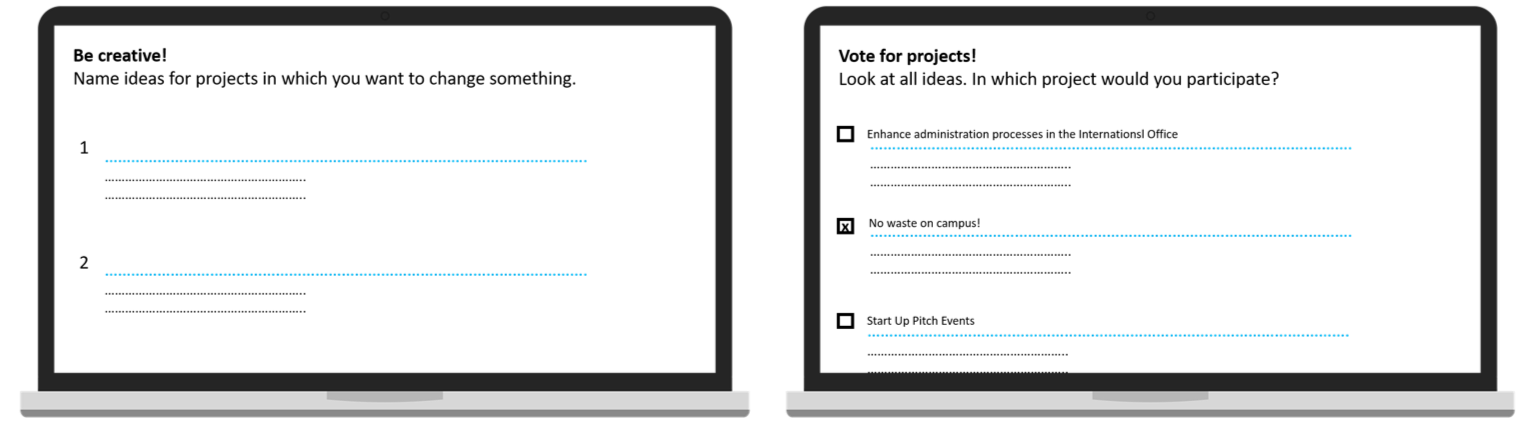 Students can hand in ideas for projects half year before they can choose the NTA. This helps to show overall problems that concerns students. The voting shows the relative importance.
Connection to existing courses
As soon as the projects are defined. Existing courses can be found. The network of courses being related to the topic can be built. Research associates and administration look for lectures being important to implement in the NTA schedule.
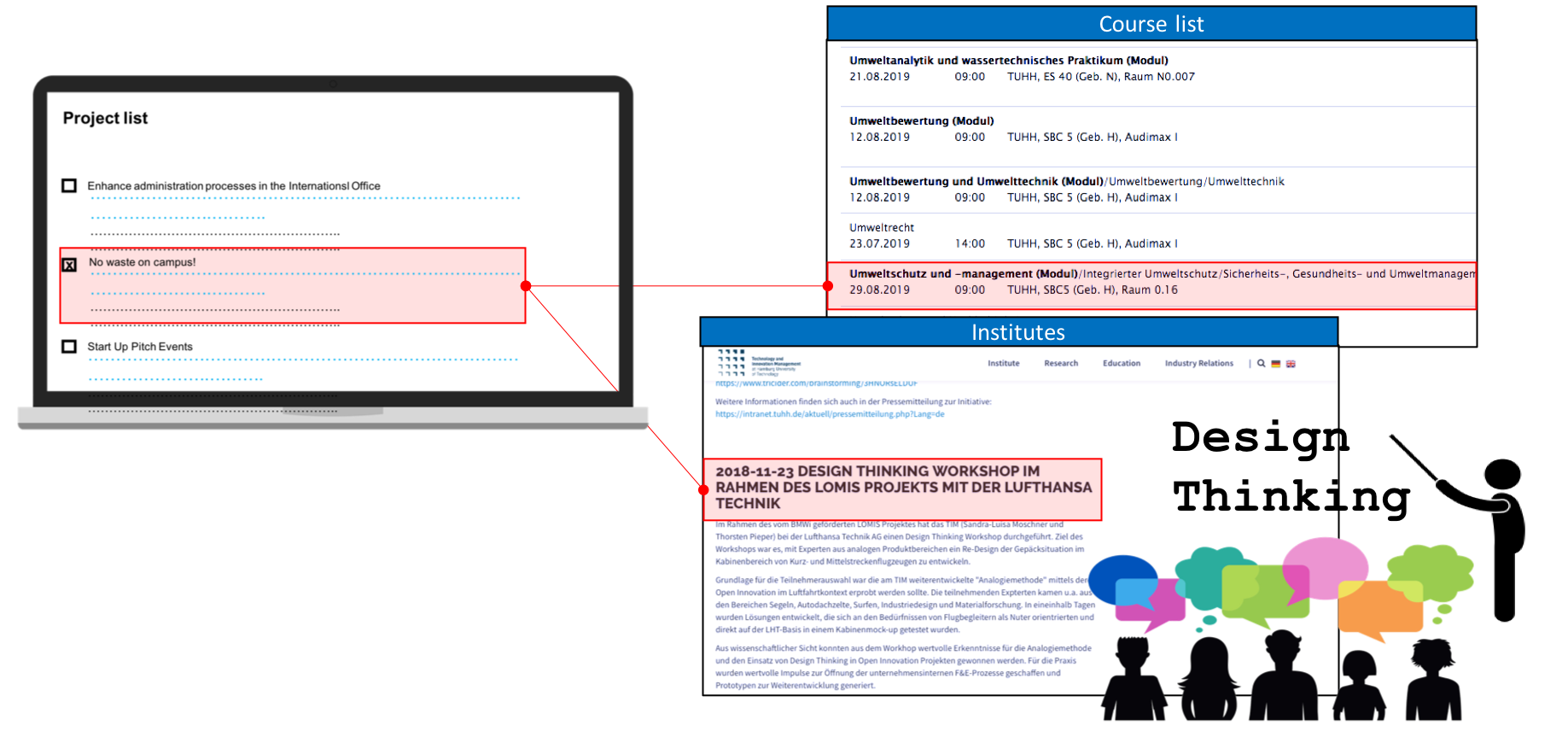
Assistance by institutes/companies
The networking includes finding institutes or companies who want to assist the student group.
Make usage of
- Institute & research facilities
- Company network
- Alumnis
Strategic Priorities
[1] Empowerment of others to change the world - We want students to uncover problems and to take action in order to improve our community.
[2] Creativity - We want the freedom for students to choose their own projects and to unfold creativity.
[3] Innovative mindset - We want students to face problem-based projects by using innovative methods.
Next Steps
[1] Gather potential project ideas
[2] Categorize them
[3] Create network (courses, institutes, companies) in advance
[4] Come up with method training & course structure
[5] Talk with stakeholder
[6] Make request for course
Project #3 - Create a universal space for innovation and entrepreneurship with existing facilities
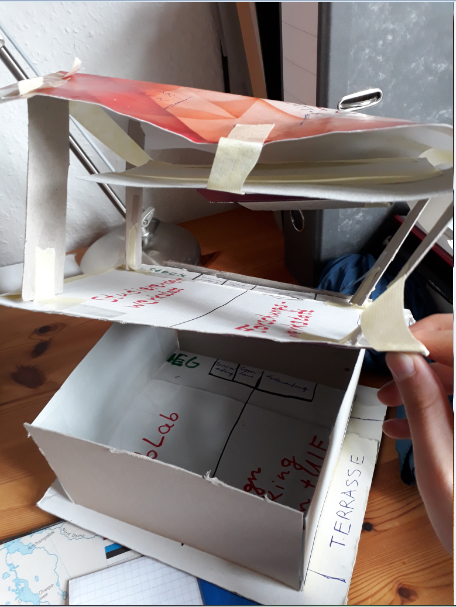
The third project has the idea of combining all existing facilities and new facilities of innovation and entrepreneurship in one building to create more awareness and transparency of the options available for students. Existing facilities are for example: FabLab, students’ workshop, research workshop. Additionally new facilities not jet existing should be implemented like a Design Thinking Room and a UIF working space. This building which could either be a complete new built or an already existing one shall be supervised by one full-time working person or two half-time working persons. The supervisor(s) would also be the people giving the safety instructions courses to make sure that people working in the facilities know what they are doing. Those courses would be obligatory for everyone who wants to work in the facilities. The workshops should mostly be led by students (e.g. UIF's) who feel responsible that everything is going the right way. In this building there should also be an option for an information board for finding a project partner, information about TUHH projects/ AG’s or information about sponsoring options.
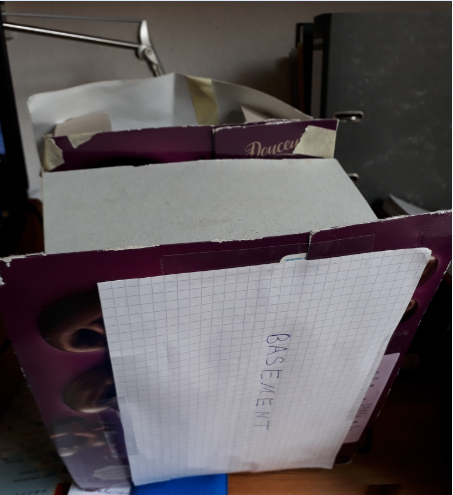
After prototyping this idea I got a lot more ideas from the people testing the different prototypes which I then decided to implement in this idea too. This includes also adding the Startup Doc and the AStA workshop to the building and creating working space outside the building by adding a terrace and balcony. Those are especially useful for working sessions that create a lot of dust or other dirt. A basement should be implemented for having enough storing space. Because of working with heavy machinery and dangerous tools a good idea implemented is to have a first aid room in this building too and escape routes should be highlighted. To make the building more sustainable a good insulation and solar electricity and solar heat panels are put on the roof. This helps save energy on one hand and also generate own electricity and hot water for heating. To make working comfortable spaces with enough daylight are implemented and short growing plants are implemented on the outside walls and on the roof of the building.

Strategic Priorities
[1] Awareness for already existing facilities and what options/ tools are available
[2] Transparency for who has access to the facilities and how to benefit from it
[3] Collaboration between different institutions of the university
[4] Promotion of TUHH by making the building a trademark of the university
Next Steps
[1] Gather more information about the room situation
[2] Find out which institute/ department is located where and options for areal expansion
[3] Make a computer model of the TUHH floor plans
[4] Improve floor plans in the computer model
[5] Talk to persons in charge for this specific problem at TUHH and with people in charge from the city of Hamburg
[6] Talk to most of other stakeholders
[7] Secure financial resources for this project
Cohort Fall 2018
Project #1 Connecting the existing elements for better synergies
The idea is to tackle the problems “lack of access” and “lack of knowledge about participants at the university” by creating a better and more convenient way to use the existing resources on campus. We learned that the problem “lack of space / resources” actually can be proven wrong by the analysis of the campus via the landscape canvas. We do have prototyping spaces (multiple!) and we do have rooms to ideate, as well as institutions helping to spin out. The conclusion is: connecting these resources instead of creating new ones.
We introduce: TUHH Feed. This application will show you a feed of different elements (introduced below) after you created your profile and narrowed down interests. The feed will show:
Projects
Projects are groups that form to tackle a problem or design a solution. This can happen in actual working groups, registered via our central students committee or in loose connections. The things necessary to be displayed are the numbers of students involved and the mission statement. It will also be able to get in contact much faster than usual, so connections get created quicker.
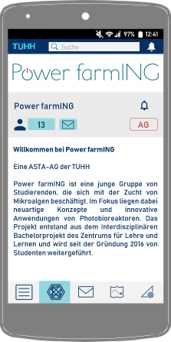
Resources
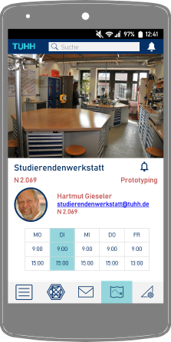
Resources range from facilities like prototyping spaces or rooms to ideate to consulting hours by professors and faculty staff eager to help. The idea is that projects will run through phases in the innovation process and can access the existing resources more convenient. The resources will also have a tag showing which phase they are ideally brought in. In this example the students workshop is ideal for the prototyping phase.
Events
We also wanted to include Events, because they can inspire students to act and also meet others that are interested in the topic the event is for. It will open the students circles and increase interactions through which projects can be started. In this example, we have an exhibition on climate change. It’s date and entry fee is stated, as well as an interactive link to the location and a small description. Students can signal participation by entering the event and also link it to their calendar.

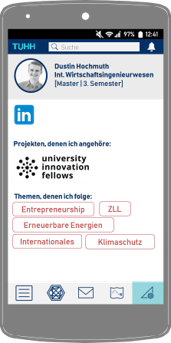
Profile
The profile is the basis for the individualized feed. It will include the name and field of study, projects you are part of and topics of interest. On this basis, all the other elements will come up in the feed and can be inspected by students. It is important to notice, that this is not a “social network” but a “university network”. It does not serve to post as an individual! As we learned, you should be a first or early follower to a leader, rather than the leader (Leadership lessons from dancing guy).
Feed
Finally, this is what I might see with my profile settings. It shows events, resources and projects that fit my interests and fields of study. If everyone simply shares who they are and what they stand for, communication and connection will spark through common interest / purpose. We believe this will unite easier and lead to better saturation of the universities existing resources.

Strategic Priorities:
[1] Unity – We want to create a unified campus that shares resources instead of creating more with bad saturation
[2] Inclusion – Students, Faculty Staff, Professors: All can take part to collaborate
[3] Purpose driven connectivity – We want to enable connections on passions to boost collaboration rather than through classes
[4] Appreciation – Now that the university has more transparency over students extracurricular activities, maybe these can be translated into new courses or “problem bases learning” sessions, again feeding the education quality and experience
Next Steps:
[1] Refine the idea wih the university stakeholders
[2] Build a detailed cost plan around a MVP version of the app
[3] Relate the app to an organizational role inside the university
[4] Secure the funding of the app (continously) and make sure it is constantly improved
[5] Develop a role out plan at the university (marketing, onboarding process,...)
[6] Transfer the app into a routine function that will include continuous improvement circles
Project #2 Raise participation at the campus through a community app
The following prototype attacks the problem of low participation at the university campus. The missing commitment of students leads to diverse problems at the campus, this is why we want to raise awareness for problems and ideas!
The prototype is an app which is based on a community voting system:
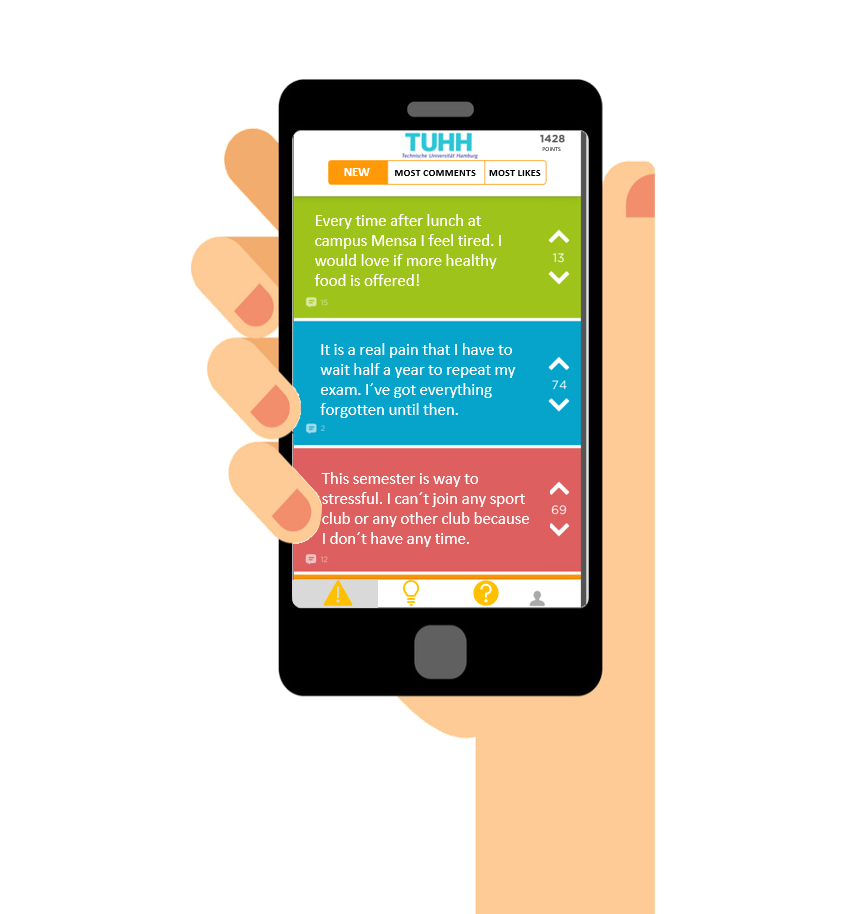
How to participate
Every student, staff or professor can log in with their university account and participate. Important is the inclusion of every member at the university. After logging in one has the possibility to post an idea or a problem which is bothering them on campus. Differing from “We don´t have a space for personal projects” to “University Mensa is too crowded to eat between lectures” and “I want to build a makerspace!”. The different ideas or problems are then listed in a feed and are presented to the community. When scrolling through the feed, the user can upvote oder downvote postings or comment them.
Not alone
The advantages are that people are not “alone” with their problems and when getting support from the community a highly voted problem might start a change making project.
Indicator
On the other side, it is a good indicator for decision makers what the actual atmosphere at the campus is.
Moderator
Important to mention is that the feed is moderated in order to maintain on a friendly basis, hence the platform does not become a place of hate speech.
Incentive
To incentivise the user a points account is introduced which tracks their activity. For students, a good participation might then rewarded with credit points at the end of their studies.
Different categories:

Problem: Identified problems on the campus -> Outcome: What bothers the university?

Idea: Ideas to solve or to improve -> Outcome: Source of innovative ideas for further projects

Q&A: Asking question to experienced students -> Outcome: Collection of answers which help students improving their studies.
Strategic Priorities:
[1] Awareness – Showing where the “real” problems are and create awareness to see the campus with open eyes for innovations
[2] Interdisciplinarity – Students (Of every department), staff or professors: Everyone is included
[3] You are not alone – Showing that you are not alone with your or any problem and raise solidarity
[4] Knowledgebase - Ensure that knowledge and experiences are transferred to next generations
Next Steps
[1] Continue testing and refining – Test the prototype on every user group (students, staff and professors) and refine
[2] Wanted? – Talk to stakeholders at the university and ask if this kind of participation is wanted
[3] Feasability – Talk to stakeholders in the IT and evaluate the difficulty of connecting the app with university log-in data
[4] Sustainability - Find the right stakeholders which are supporting the idea and are willing to be responsible for keeping the app running
[5] Contact app developer – Reach out for a developing team. Best scenario would be a a team based on students and staff of the university
Project #3 Create a better system for money distribution
The next idea is a practical way to distribute money in the university for student clubs. How money is handled at universities student clubs, which are fully organized by students is less transparent and most of the spent time in these student clubs are used to organize money.
The idea behind a fair transparent system is to create a money pot which can only be used by the student student clubs. This application process is 3 steps, which are handled once a year to dispense the money between the student clubs.
Who can Participate?
Every student clubs can access this money if there are students that support their idea and participate in the application process.
Step 1: Registration of needed money
The first step is for each student club that wants to access the money has to submit how much money they need for the student club
Step 2: Provision of the money
The money pool for this year is defined. This means that each student club knows how much money is available this year. With this approach, the head of money can still control how much money is used for student clubs in general. It shows transparency for the complete university.
Step 3: Presentation of each applicant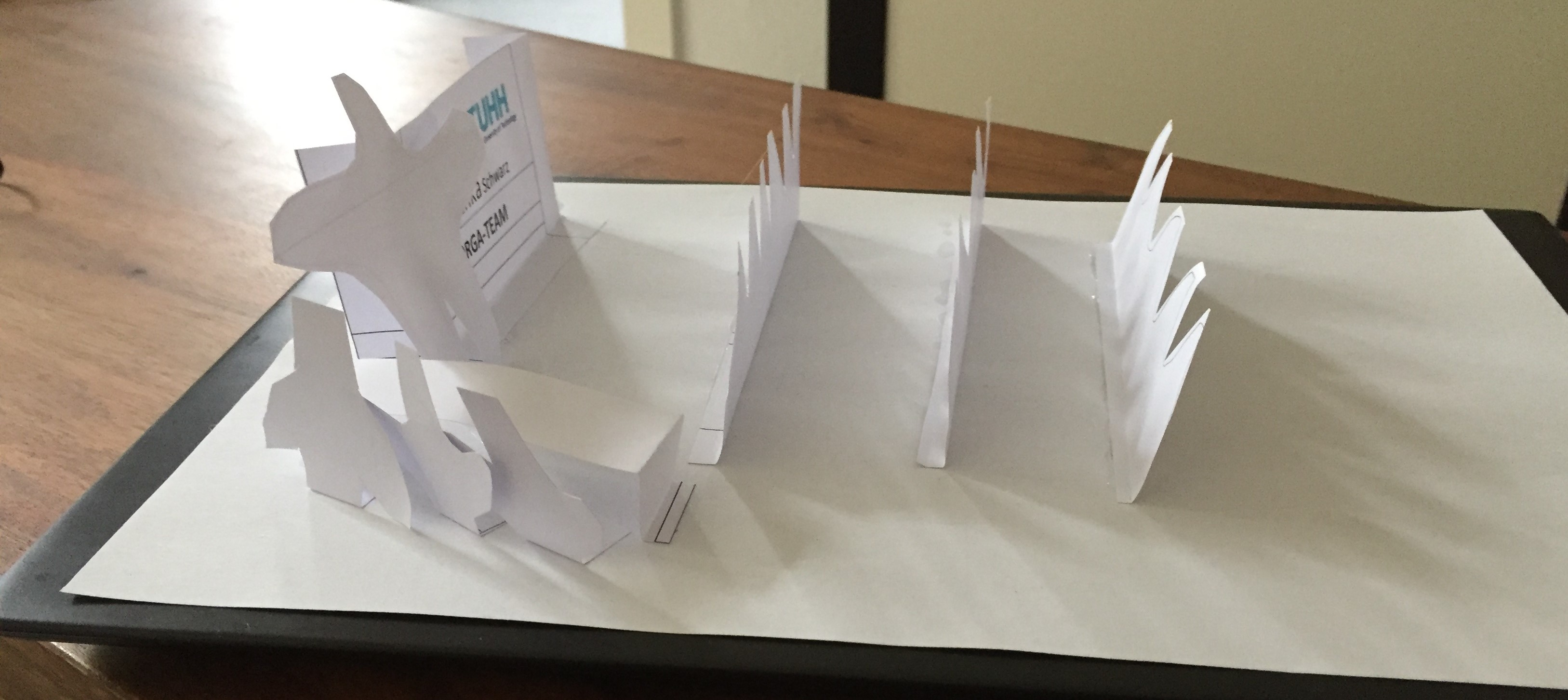
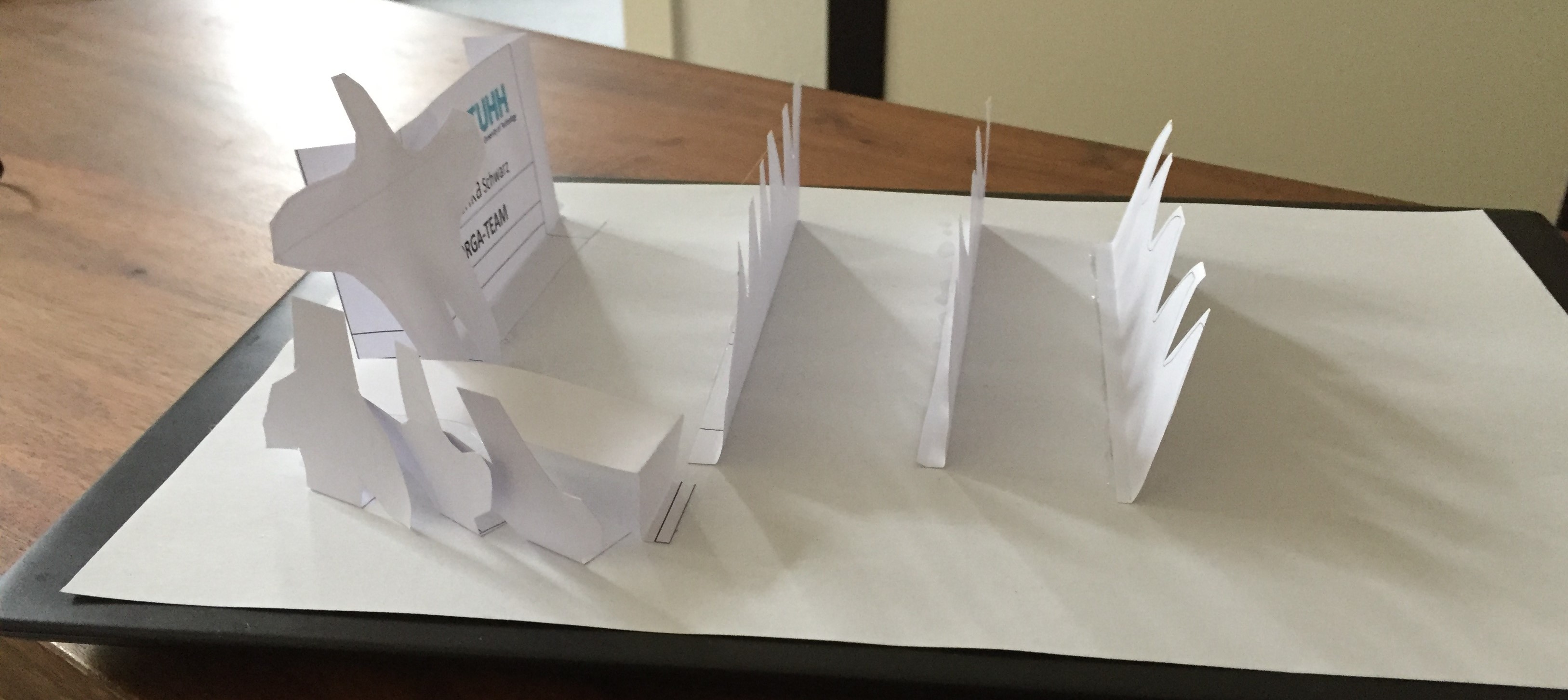
Now after everyone knows how much money is available, each student clubs prepares a pitch deck like a startup pitch, where each team presents what they want to do with their money. The jury consists of each participating team itself, that means students, and not the administration itself.
Each team must rate each other team how much of the money, they applied, should be granted. In the end, the mean value is used.
One important aspect behind it is, if your team values good teams badly, there is a negative feedback such that your student clubs gets less money.
With a system like that, we have the opportunity to value the projects that are important for the students and not for the head of the university. Or different faculties where the money currently comes from.
Bringing the project to life
This big change where a lot of risks is involved has to be backed up by a lot of students as well. The idea of how we can bring the university to this change is to actually talk to the leaders of each student club. Convincing them is the best way to actually create a change at our university. If we go top down in this problem we would have to convince the leader of the university first. The other way around down to top is a better strategy here. With enough students that are supporting that idea, we can create pressure on the university to actually support the idea.
This means the first step is to convince a lot of student club to support this idea.
Utilize support to actually bring this project to life for a fair transparent distribution of money.
Strategic Priorities:
[1] Transparency – Showing transparent which resources are used for what project
[2] Entrepeneurship – Students learn effective pitching their ideas
[3] Acknowledgment – Acknowledgment for different student projects
[4] Increased Popularity – The announcement increases popularity for every student student club
Project #4 Creathon @ TUHH
At TUHH we identified the following major issues:
[1] We have a lot of I&E assets but they are neither used, known nor do they cooperate with each other.
[2] We have low participation in student activities due to a high workload and missing interest
[3] We don't have a strong togetherness-feeling. Instead, people just go to the lectures and exams.
[4] Students would like to engage in innovative processes but are too shy to it themselves.
The organization would be done by us and everyone who has interest to help us (a lot of people actually signalized their help when talking about the idea).
The problems / challenges found in the daily campus life should preferably posted and subsequently ranked by all university members encouraging all to solve their own stated problems and to participate in the creathon. Additionally, teams could bring their own challenges they want to solve or they are given by external companies which could be a possibility of financing the event.
The teams should not only consist of students but of all university members (e.g. faculty staff, professors, etc.) to build inclusive teams creating solutions for the whole university.
To inspire the teams for an innovative mindset keynote lectures should be held by local founders (experiences/failing is part of the process), professors (scientific/educational purpose), and/or companies (experiences/need for innovations). Following, we would give an introduction to the design thinking process and provide additional input and material throughout the different steps.
The first two phases of the process, inspiration and ideation, should take place in the LUK (Learning and Communication Centre). Then, the prototyping is done either in the student workshop or in the Fab Lab, both facilities which are not well known by students.
Finally, the teams present their ideas in front of a jury consisting of university members, founders, accelerators, and sponsors of the event (e.g. companies). The whole presentation and award ceremony should be accompanied by the university’s marketing department to achieve a university- and city-wide acknowledgement. The winning teams are awarded with money/space/resources to implement their ideas.
Strategic Priorities
[1] I&E Mindset - Students start developing a more innovative and entrepreneurial mindset
[2] Awareness - Students get to know the I&E assets of their campus
[3] Sustainable Improvement - Solving problems of the university by the university
[4] Inclusion - Increase togetherness-feeling of all university members
[5] Brand - Positioning as an innovative university
Next Steps
To bring the creathon to life we have to do the following steps:
[1] Develop a detailed concept of the creathon.
[2] Convince the stakeholders of the concept.
[3] Secure funding of the creathon.
[3] Prepare a Design Thinking workshop for the input along the creathon.
[4] Acquisition of I&E partners (founders, accelerators, companies, etc.)
[5] Start a university wide marketing campaign to raise awareness of the project.
[6] Collect problems/challenges.
The biggest challenge for us will be the development of a very good concept ensuring that the participants are really motivated afterwards and spread the word for upcoming creathons. If we fail to deliver, it will be even more difficult to gain the interest of new participants than before.
Related Links
Hamburg_University_of_Technology
Fall 2019 Cohort
Related links


